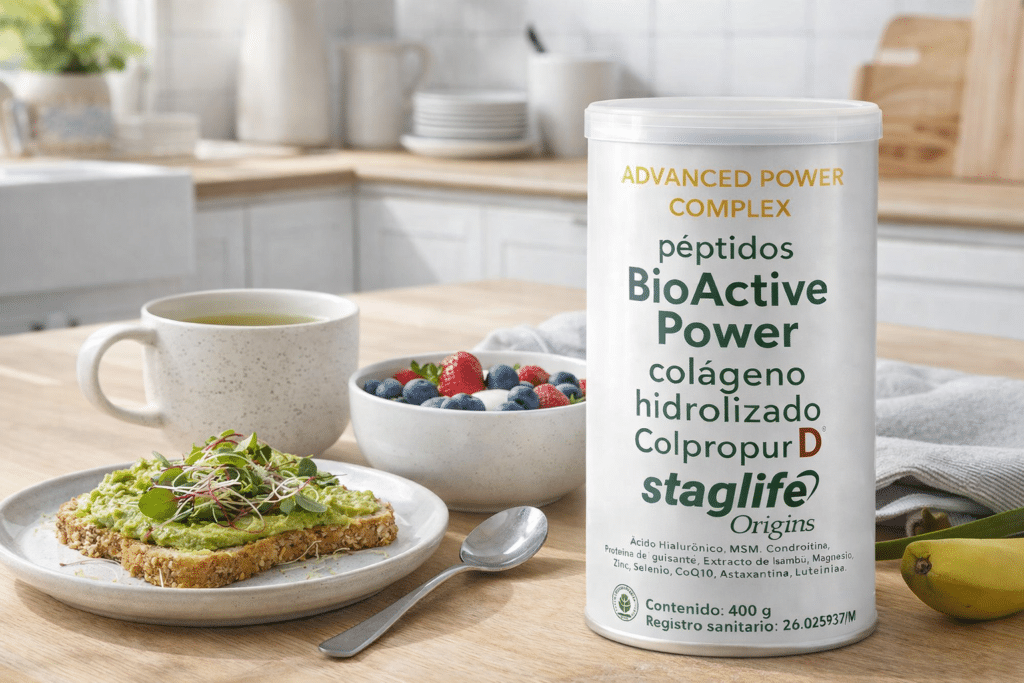
For years, collagen has lived on an uneasy borderline: halfway between aesthetic promise and basic biology. Today, however, the debate has changed. It is no longer a question of whether collagen is important - because it is - but whether taking it actually has an impact.
And the answer, as is often the case in physiology, is neither a resounding yes nor a categorical no. The answer, as is often the case in physiology, is neither a resounding yes nor a categorical no.
It's not what you take, it's what your body does with it.
Collagen is the most abundant structural protein in the body. It is part of skin, tendons, cartilage, bones and blood vessels. It is, in essence, the architecture that supports the body.
From the age of 25-30, its synthesis progressively decreases while its degradation increases. The result is not only visible on the skin: it affects tissue elasticity, muscle recovery and joint function.
But there is a key nuance that is often overlooked: when we ingest collagen, the body does not transport it directly to the skin or joints. It breaks it down. Into amino acids and, above all, into small fragments called collagen peptides. And that's where it gets interesting. Some of these peptides not only provide raw material, but also act as cellular signals capable of stimulating fibroblasts, the cells responsible for producing new collagen.
It is not replacement. It is regulation.
What the evidence says (and what it doesn't)
The most consistent scientific literature points to modest but measurable effects:
- improved skin elasticity and hydration after several weeks of continuous use
- reduction of pain in joints with mild to moderate wear and tear
- indirect support for tissue recovery in active people
There are no immediate effects or radical transformations. But neither is it a placebo with no physiological basis. The problem is different: its scope has been overestimated.
Collagen does not massively regenerate tissue, it does not reverse ageing and it does not replace fundamental habits such as nutrition or exercise. It works, yes, but within very specific limits.
The mistake of talking about “collagen deficiency”.”
One of the most repeated - and most inaccurate - concepts is that of “collagen deficiency”. This is not how the body works.
No direct clinical deficit comparable to that of a vitamin. What happens is a imbalance between synthesis and degradation, influenced by factors such as age, oxidative stress, inflammation and sun exposure.
And here is a key question that is rarely asked: If the body is not able to synthesise collagen properly, what is the point of supplementing it? The answer depends on the context.
When supplementing does not work (or does little)
If there is a real blockage in the synthesis - for example:
- vitamin C deficiency
- zinc or copper deficiencies
- chronically elevated inflammation
- glycation associated with metabolic disturbances
providing collagen does not solve the problem.
Because not a lack of raw materials, but a lack of functioning.
In these cases, the supplement may be metabolically irrelevant: the body digests it, uses it as a general protein, but does not effectively transform it into structural collagen.
It does not cause harm under normal conditions, but neither does it have the expected effect.
When it can make sense
The most common scenario is not a complete failure, but a loss of efficiency:
- synthesis slows down with age
- degradation increases (stress, sport, UV radiation)
- demand for textiles is higher.
Here the body can produce collagen, but needs more stimulation and support.
This is where collagen peptides make the difference. They not only provide amino acids: they act as cell modulators that promote fibroblast activity. This is why their effect does not depend solely on the amount of protein ingested.
Are all collagens the same?
No. Hydrolysed collagen - fragmented into low molecular weight peptides - has shown the greatest consistency in general clinical studies.
But within this category there are relevant differences: origin, purity, amino acid profile and manufacturing processes are more influential than is often reported.
And then there is the formulation.
The current trend is no longer to offer collagen in isolation, but to integrate it into larger matrices with vitamins, minerals and other bioactive compounds.
From a physiological point of view, it makes sense. Collagen synthesis depends on cofactors, especially vitamin C, without which the process stops.
However, not everything that is added brings real value. Some combinations respond to clear biological mechanisms, others to a commercial rather than functional logic.
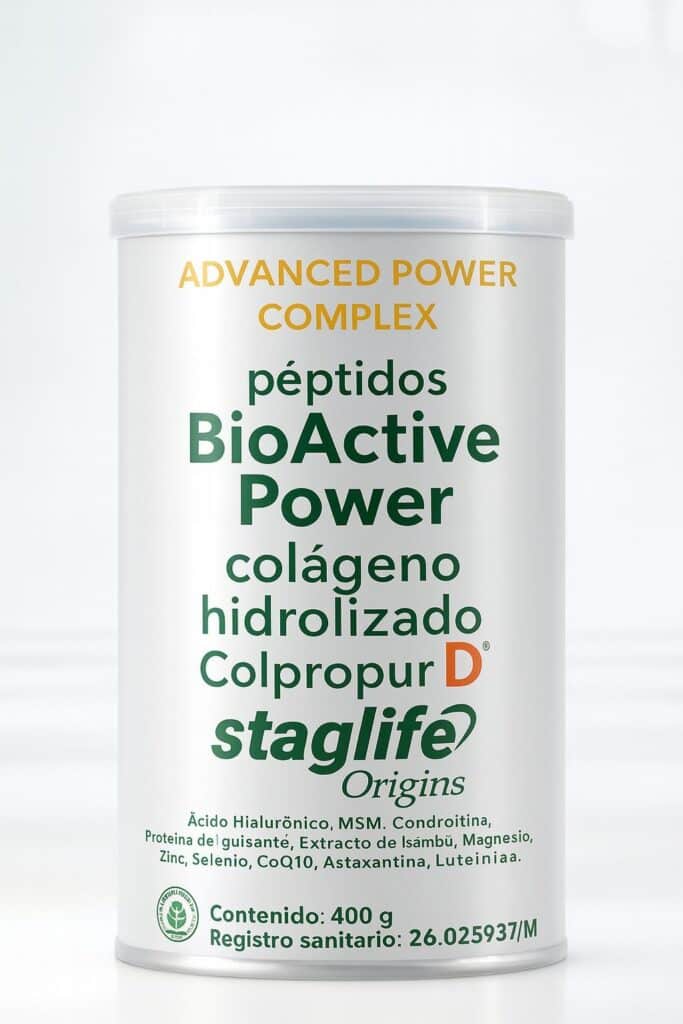
A recent example is STAGLIFE Bioactive Power, which combines 5,000 mg of hydrolysed collagen with more than twenty ingredients, including hyaluronic acid, MSM, coenzyme Q10 and antioxidants.
The basis is correctThe question is: appropriate dosage, powder form - key to achieving effective amounts - and the presence of relevant cofactors. The unknown is in the mix. When a formula accumulates so many active ingredients, it is difficult to attribute specific effects and to differentiate between real synergy and unnecessary complexity.
Who should take it?
It is not a universal supplement.
It can make sense in:
- people aged 30 and over
- athletes with a high mechanical load
- skin exposed to photoaging
- incipient joint processes
And it will probably have little impact on:
- healthy young population
- diets already balanced and sufficient in protein
- contexts where the problem is metabolic, not structural
How to take it (and why it really matters)
The powder form is, in practice, the most effective. It allows doses of between 5 and 10 grams per day to be achieved, which is what has been used in studies. Capsules, by volume, rarely reach these amounts.
As for the time of day, there is no solid consensus. It can be taken on an empty stomach or after exercise, but the determining factor is not timing, but consistency. Collagen does not act in peaks. It acts by accumulation.
Hydrolysed collagen is not an empty fad, but neither is it the global solution that many narratives suggest: its efficacy exists, but it is specific, gradual and dependent on the biological context. It does not replace habits, it does not correct metabolic dysfunctions on its own and it does not work the same for everyone.
The key is not to take more collagen, but to understand whether the body is able to use it.
Because, ultimately, the real issue is not how much collagen we ingest, but how much we are able to build.
(Royalty-free photos, provided for distribution))