
The story of GLP-1s began in diabetes and reached the general public through the scale. Semaglutide, tirzepatide and, soon, even more potent molecules like retatrutide have turned weight control into one of the fastest-growing pharmaceutical markets in the world. The scale of the phenomenon suggests that perhaps we are looking at the business from the wrong angle.
In the United States, 11% of adults report currently taking a GLP-1 medication for weight loss, compared to 3% recorded by Gallup in 2024. Another 15% say they have used one at some point to lose weight. This figure does not represent all GLP-1 users, as it excludes those taking them primarily for diabetes or other indications, but it gives a sense of the scale: applied to the U.S. adult population, that 11% equates to around 29 million people.
The phenomenon also has a dimension that is beginning to shift the medical conversation. Clinical trials have shown cardiovascular and renal benefits that cannot be explained solely by the number of kilos lost. Semaglutide reduced major cardiovascular events in people with overweight or obesity and established cardiovascular disease, while accumulated evidence also points to benefits in kidney disease and other disorders closely linked to metabolic health.
The question, therefore, is beginning to change: are we looking at extraordinarily effective weight-loss drugs or a new generation of tools for reducing the risk of chronic disease?
The effect you see and the ones you don't
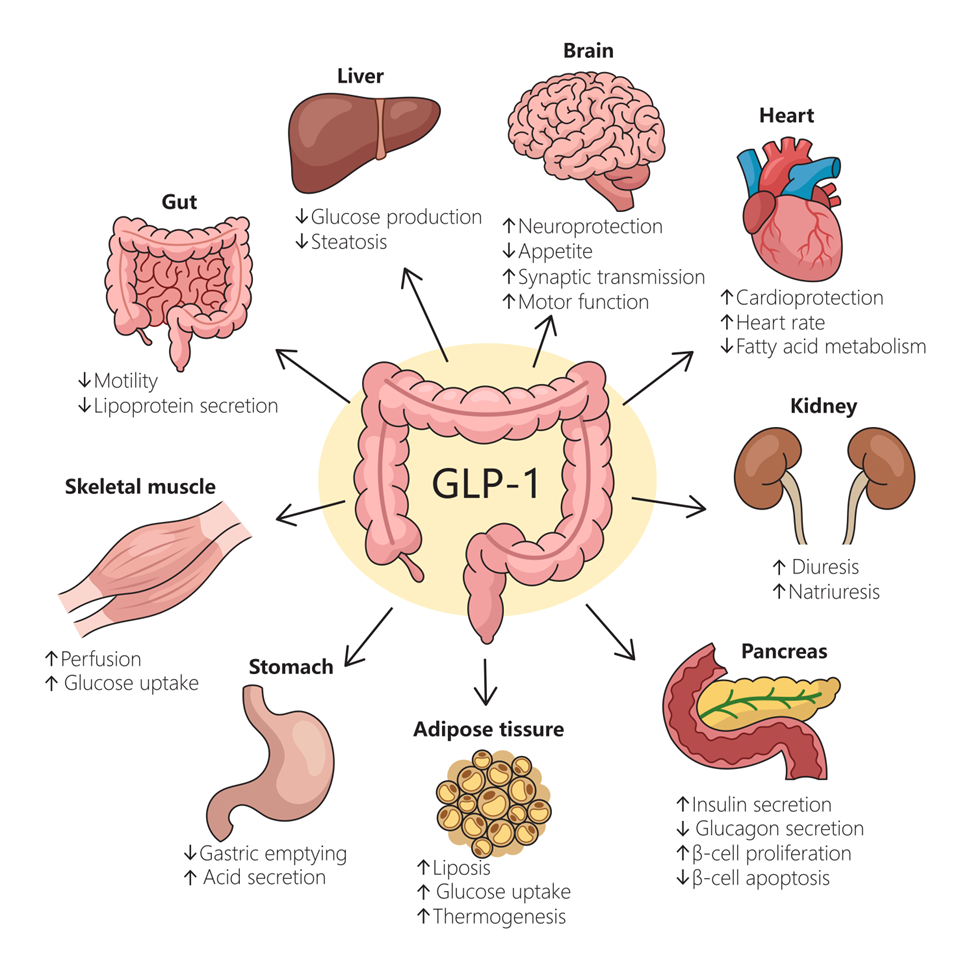
The mechanism is far more interesting than the before-and-after photo. GLP-1 agonists mimic an intestinal hormone involved in insulin secretion, glucagon control, gastric emptying and the brain's regulation of appetite. The most obvious result is reduced food intake and significant weight loss.
The potentially most far-reaching benefit may occur far from the mirror.
Weight loss improves blood pressure, blood glucose, insulin resistance and certain metabolic markers, but some trials have also demonstrated a reduction in cardiovascular events in selected patients. Research is expanding into kidney disease, heart failure, obstructive sleep apnea, metabolic liver disease and osteoarthritis. Not all of these indications have the same level of evidence yet, nor are they approved for all drugs — a fundamental distinction in a market where advertising often moves faster than regulation.
Mental health represents another area of research. A study published in The Lancet Psychiatry, based on records from nearly 95,000 people with type 2 diabetes, found an association between semaglutide and a lower risk of worsening of certain mental health disorders. The finding is interesting, but it does not turn semaglutide into an antidepressant: part of the effect could come from better metabolic health, weight reduction or changes in factors associated with the disease.
For longevity medicine, this distinction is especially relevant. GLP-1s are not yet anti-aging drugs. Their interest lies in the fact that they could act on several of the processes that shape healthy years of life: visceral obesity, insulin resistance, diabetes, cardiovascular disease, kidney decline and loss of functional capacity. Preventing those diseases may contribute to living more years in better condition, but that does not amount to having demonstrated that the drug extends life.
From semaglutide to retatrutide: the race for the next generation
The pharmacological evolution is revealing. Semaglutide acts on GLP-1; tirzepatide combines GLP-1 and GIP; retatrutide adds the glucagon receptor to both and becomes a triple agonist.
The available phase III results explain the excitement. In TRIUMPH-1, retatrutide produced a mean weight loss of 28.3% at 80 weeks with the 12 mg dose, and 45.3% of participants achieved at least a 30% reduction in weight. The company is also developing trials targeting sleep apnea, osteoarthritis, cardiovascular and kidney disease, and metabolic liver disease.
Retatrutide, however, remains an investigational drug. Lilly plans to submit the application to the FDA in 2027, and its legal use is limited to clinical trials. Buying products sold online under that name is not the same as accessing the drug used in the studies.
The progression from one molecule to another hints at the sector's true economic potential: the competition is not just about who can make people lose more weight, but who can intervene in an ever-growing range of metabolic diseases.
The price of losing weight and the price of not doing so
Cost is one of the reasons explaining the reluctance of public health systems to fund these treatments broadly.
A GLP-1 can cost several thousand euros a year for a patient who has to pay out of pocket, and in many cases the treatment is not conceived as a short-term intervention. The budgetary problem appears immediately: if millions of people need chronic treatment, even a relatively moderate amount per patient translates into billions for the health system.
The interesting economic comparison, however, is not between a box of medication and a diet.
It is between the cost of treatment and the cost of the diseases it can help prevent.
Type 2 diabetes, hypertension, cardiovascular disease, kidney failure, sleep apnea, osteoarthritis, and other obesity-related conditions generate medical and social costs for years. From a health economics perspective, an expensive medication can be reasonable if it sufficiently reduces those costs and, above all, if it prevents serious events.
France has taken a significant step in this direction: since June 2026, Wegovy and Mounjaro are covered under certain conditions within its health insurance system.
The United Kingdom has also begun incorporating the concept of cardiovascular prevention into the evaluation of semaglutide. NICE recommends its use in certain adults with established cardiovascular disease and a BMI of at least 27, precisely because the intended benefit is not solely weight loss, but reducing the risk of heart attack, stroke, and cardiovascular death.
For Spain, the question is therefore not whether GLP-1s «work.» The question is for whom funding them is sufficiently cost-effective in health terms.

Why not give them to everyone?
Because efficacy and cost-effectiveness are not synonymous. For a person with obesity, diabetes, hypertension, and cardiovascular disease, the potential balance can be extraordinarily favorable. For someone with normal weight who wants to lose five kilos, the equation changes dramatically.
There is also a duration issue. Obesity is chronic in nature, and a significant portion of lost weight can be regained after stopping treatment. An intervention that requires maintaining the medication for years represents a very different economic burden than a six-month treatment. A recent analysis published in BMJ highlights precisely that weight loss achieved with these medications is not usually maintained after discontinuing them, and that the most effective drugs may also be associated with more adverse effects and loss of lean mass.
Public funding also requires selecting patients, monitoring side effects, and evaluating outcomes. Prescribing the medication is only one part of the treatment.
The uncomfortable side: they are not harmless
Nausea, vomiting, diarrhea, and constipation are among the most common adverse effects. In an analysis of more than 410,000 Reddit posts related to semaglutide and tirzepatide, 43.5% of users describing their experience mentioned at least one side effect; nausea appeared in 36.9%, fatigue in 16.7%, vomiting in 16.3%, constipation in 15.3%, and diarrhea in 12.6%. These data come from online communities and cannot be used as clinical incidence rates, but they do offer an interesting snapshot of the experience perceived by users.
There is also a less visible issue: what kind of weight is lost. Rapid reduction can include muscle mass along with adipose tissue, something especially relevant in older adults. The use of these medications within a longevity program should be accompanied by adequate protein, strength training, and body composition monitoring.
GLP-1s are not all injectable. Oral formulations exist, although current options are considerably more limited than injectables. Getting peptides to be effectively absorbed orally is considerably more complicated than injecting them, because they are large molecules that can be degraded in the digestive tract. That is why the emergence of effective oral formulations is important for the future of the market.
If GLP-1s progressively shift from injectable medications to oral treatments, one of the main psychological barriers to chronic use disappears, and they could move even closer to the mass market for cardiometabolic prevention and longevity.
The other side of the phenomenon is the parallel market. The popularity has generated counterfeit products, unauthorized preparations, and dosing errors that can turn a treatment with a known safety profile into an unpredictable intervention.
The new business opportunity may lie in risk, not weight
The industry is beginning to compete for something much bigger than the diet market.
If a medication can simultaneously reduce weight, blood glucose, cardiovascular risk, and renal complications, its potential market is no longer made up exclusively of people who want to lose weight. It expands toward the prevention and treatment of chronic diseases that consume a huge share of healthcare resources.
That also explains why it is premature to call GLP-1s «longevity drugs.» The hypothesis is appealing, but medicine needs to demonstrate more than a logical chain of metabolic benefits. It needs to know whether those benefits translate into more years of life and, above all, more years of healthy life.
While that answer arrives, GLP-1s hold a unique position: they are medications designed to treat metabolic diseases that are revealing potentially relevant effects on many other systems in the body. That may be where the real market lies.
Whether a person weighs less in itself is not as relevant as reaching 70, 80, or 90 years old with less cardiovascular disease, better metabolic function, less disability, and greater autonomy.
The public healthcare system can choose whether to invest in education so that the population (from a young age) does not become overweight, or pay for lifelong medication to prevent the diseases caused by obesity and diabetes..