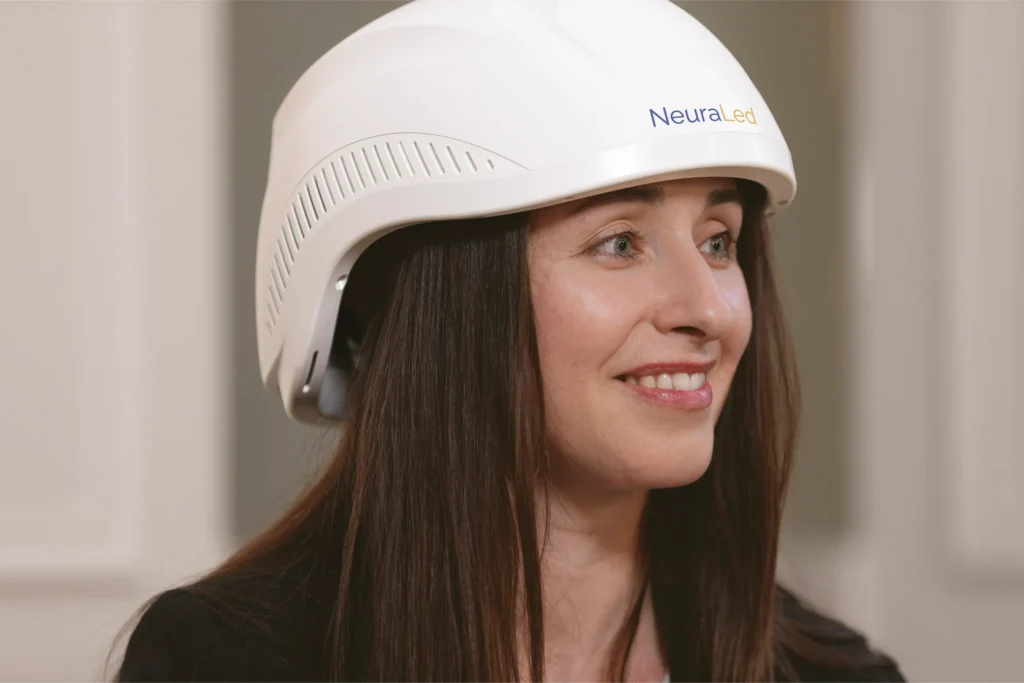
We spoke with Julien Boutillier about Neura LED, a French neurotechnology company that develops Axion, a transcranial photobiomodulation device designed for general wellness, cognitive performance, and brain longevity.
Photobiomodulation uses red and near-infrared light and has a growing body of scientific research. With Julien, we explore the principles of brain photobiomodulation, the importance of dosimetry, protocol personalization, and how to integrate this technology into professional wellness and longevity settings.
Q: To contextualize the origins of this technology, how did the development of NeuraLed Axion come about, and what is its scientific cooperation model?
Julien Boutillier: NeuraLed is a French neurotechnology company. Axion was developed through an extensive R&D phase, prototyping, and technical testing, with several successive versions leading to the current device.
Our scientific development is carried out with our team under the scientific direction of Prof. René-Jean Bensadoun, particularly around photobiomodulation and dosimetry. We then work with specialized industrial partners for manufacturing according to our specifications, as well as with professionals, clinics, and research partners internationally.
Q: There is some confusion about the categorization of this type of equipment. Is Axion considered a medical device or a wellness device?
Julien Boutillier: Axion is currently a general wellness device and is not a medical product. It is designed to support general wellness, relaxation, mental clarity, performance, and overall brain wellness.
It is not intended to diagnose, treat, cure, or prevent any disease or mental health disorder.
Its purchase does not require a medical prescription.
Q: There are aesthetic masks, light panels, and body cabins on the market. What sets Axion apart from a conventional aesthetic LED device?
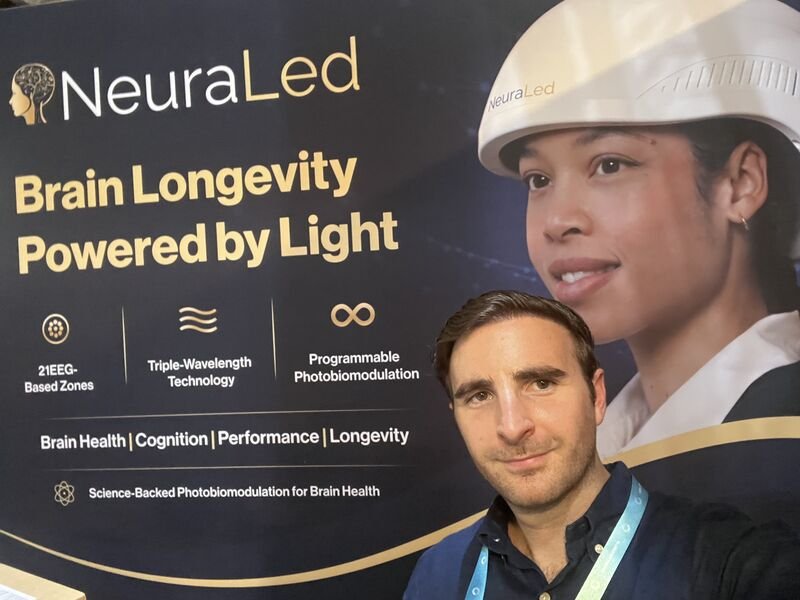
Julien Boutillier: What sets Axion apart is, above all, its architecture. The device simultaneously combines three wavelengths (660, 810, and 1070 nm) with 330 LEDs distributed across 21 independently programmable zones, including 30 ultra-high-power LEDs.
These 21 zones provide full-head coverage and allow the professional to adjust parameters such as intensity, pulse frequency, and duration per zone. This combination of coverage, power, regional control, and personalization is what distinguishes Axion from a conventional aesthetic LED device.
Q: You have emphasized dosimetry. Why is it so important?
Julien Boutillier: Dosimetry is fundamental in photobiomodulation. The biological response depends on a combination of parameters, including wavelength, irradiance, exposure time, pulse frequency, and the application zone.
In photobiomodulation, more light does not necessarily mean a greater effect. That is why dosage and protocol parameters are an important part of our work with our scientific director, Prof. René-Jean Bensadoun, who has extensive experience in photobiomodulation and dosimetry.
Q: Does Axion use only light, or is it combined with electrical stimulation?
Julien Boutillier: Axion relies exclusively on photobiomodulation and does not apply electrical stimulation. However, it can be integrated into broader wellness or longevity settings where different complementary technologies are used together.
Q: How is the experience personalized for each user?
Julien Boutillier: Axion features 21 independently programmable zones, aligned with the international EEG 10-20 system. Professionals can adjust parameters such as intensity, pulse frequency from 1 to 999 Hz, and duration per zone.
For professionals who want to go further, personalization can also incorporate wellness questionnaires and, when relevant, EEG/qEEG data. This information can help guide and refine an individualized wellness protocol over time.
In this context, EEG/qEEG is used to provide information about brain activity and support personalization, not as a medical diagnosis.
Q: For those who use it directly, does it have preset programs?
Axion includes five built-in wellness protocols (Sleep, Calm, Clarity, Recovery, and Longevity), designed to offer a simple experience with predefined parameters. Professionals can also use the customizable mode to create more individualized protocols.
Q: What is the usage protocol and recommended duration?
Julien Boutillier: The duration and frequency of sessions depend on the selected protocol and the context of use. Axion offers short predefined sessions, as well as a customizable mode for professionals.
In all cases, the device must be used in accordance with the recommended parameters and instructions for use.
Q: Does the user need to remain still during the application?
Julien Boutillier: It depends on the protocol:
- For programs focused on relaxation or sleep (Sleep, Calm), it is ideal to be calm, resting, or reading.
- For programs focused on performance (Clarity), the user can actively work in front of a computer. Axion can be powered via a cable connected to a mobile phone or an external battery (power bank) stored in the pocket.
Q: What immediate sensations does the user experience?
Julien Boutillier: The experience may vary from one person to another. Some users report sensations of relaxation, clarity, or energy after their sessions, but we do not promise an immediate effect and individual experiences may vary.
Q: If someone decided to use Axion for several hours a day to accelerate results, could it be harmful?
Julien Boutillier: In photobiomodulation, more does not necessarily mean better. That is why we insist on respecting the recommended session durations, parameters, and instructions for use. Proper dosing is an important part of photobiomodulation.
Q: What is NeuraLed's distribution model?
Julien Boutillier: We operate primarily through a B2B2C model, working with professionals, clinics, longevity centers, premium wellness operators, and distribution partners in various international markets.
Depending on the partner, Axion can be used on-site or integrated into a home-use program supervised by professionals. Beyond the device, we also support professionals with training, protocol customization, and ongoing scientific support.
Q: In conclusion, why is brain health a central pillar of longevity?
Julien Boutillier: Brain health remains, in our view, one of the least represented pillars of longevity. Sleep, stress, cognition, energy, and overall wellness are deeply interconnected.
This is the approach behind NeuraLed: bringing cerebral photobiomodulation into the realm of wellness and longevity with greater personalization, measurement, and professional support.