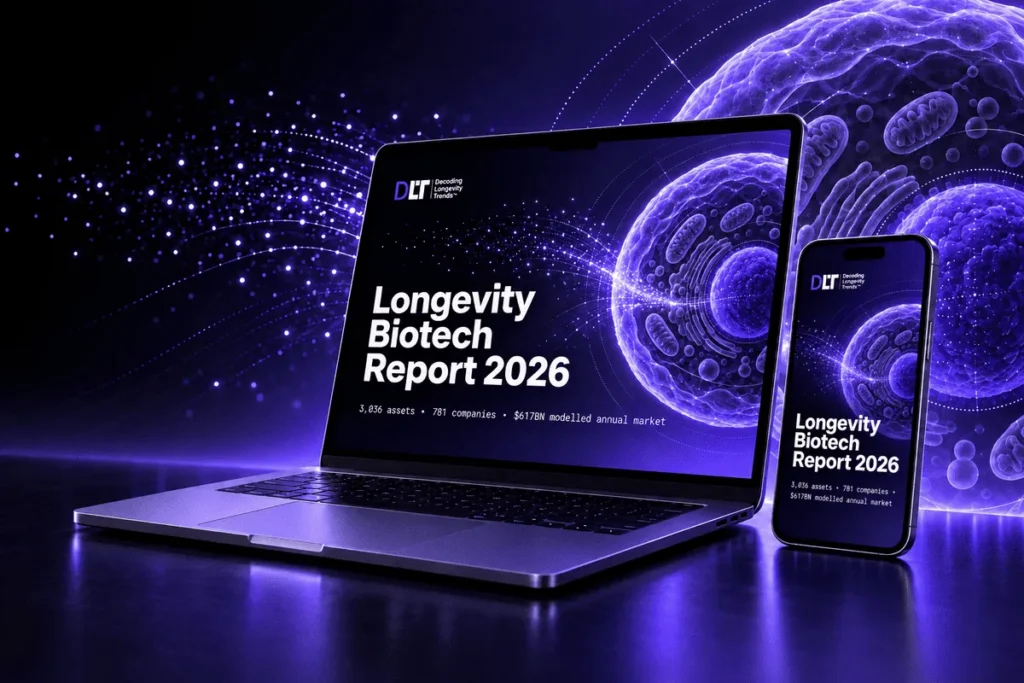
Market projections, investment, key players. The 2025/2026 period report explaining why longevity therapies are about to transform medicine. Based on the proprietary system DLT (Decoding Longevity Trends), which analyzes more than 780 companies and some 3,036–3,591 individual therapeutic assets. Report sponsored by MuseCell Innovations; independent editorial control. Authors: Longevity.Technology (Phil Newman, Christine Belleza, Arwin Atis)
The four figures that structure the entire report
- $617,000 M: projected global annual revenue for 2045 (full “gerotherapeutic” market, top-down model).
- $230,000 M/year: revenue already projected from the current SMID-cap pipeline (3,036 assets, 781 companies), generated only within already-approved disease pathways — without counting any “longevity” value.
- +$173,000 M/year additional (peak in 2052) if a gerotherapeutic regulatory category is formally recognized — added to the previous figure gives $403,000 M/year in total potential revenue from the already-existing pipeline.
- +$30,000 M invested in less than 2 years (2025-2026 YTD).
Part 1-3: The size of the prize and the ROI
TAM model (total addressable market): the report builds a “top-down” model with deliberately conservative assumptions: global market, start of preventive treatment from age 45, price equivalent to GLP-1s (~$6,000/patient/year), a 35% maximum adoption of the eligible population, and a 10-year diffusion curve from first approval (set at 2035). With these parameters, the market reaches $617,000 M/year in 2045.
The “100x ROI”: a peer-reviewed study in Nature Aging (Scott, Ellison and Sinclair) calculates that slowing aging enough to add 10 years of life expectancy in the U.S. would have a value of $366.8 trillion (trillion in English) for the U.S. economy — equivalent to $7.2 trillion/year with a 2% discount rate (33.6% of U.S. GDP in 2019).
- The U.S. intervention market alone (over 45) would capture about $330,000 M/year in 2045.
- Compared with the 10-year social value: return of ~100x.
- Compared in terms of annual rate: return of ~22x.
Interactive tool: the report includes a “TAM Explorer” where region, starting age, price base, maximum adoption, market ceiling and approval year can be adjusted to recalculate the model.
Part 4-5: Will “gerotherapeutics” actually be approved?
- Neither the FDA nor the EMA yet recognizes “geroscience-guided” clinical endpoints as a formal basis for approval.
- GLP-1s (semaglutide, tirzepatide) are considered the proof of concept: executives at Novo Nordisk and Eli Lilly already openly describe them as “longevity drugs.”.
- At the H-SPAN Summit in Washington (June-July 2026), officials from the FDA, CMS (including Dr. Mehmet Oz) and ARPA-H showed growing interest, although they noted that the lack of validated biomarkers remains the main regulatory obstacle. There is bipartisan support in Congress for incorporating a “Multi-Disease Therapeutic Breakthrough Designation” into the PDUFA VIII reauthorization.
- Dr. Nir Barzilai (Albert Einstein College of Medicine) proposes 4 conditions for a drug to be a true “gerotherapeutic”: acting on the biology of aging, extending healthspan, having solid human data, and reducing overall mortality. GLP-1s meet 3 of 4 conditions (healthspan extension in dedicated trials remains to be demonstrated).
- Critical note: the weight-loss benefit of GLP-1s may be counterproductive in populations with already low BMI (e.g., India), because up to 20-40% of weight lost is lean mass, which could accelerate sarcopenia.
Terminology: the sector debates between “geroscience,” “longevity” and “gerotherapeutics.” The report uses “Longevity Biotech” as a market category and “gerotherapeutic(s)” for specific assets. It also revives Longevity.Technology's own framework of 10 Levels of Longevity (from Level 1, lifestyle management, to Level 10, corporeal/consciousness preservation), focusing the analysis on Levels 5-8 (treatment, prevention, targeted reversal and systemic reversal of aging).
Part 6: $230,000 M today, gerotherapeutic optionality tomorrow
- Methodology: each of the 3,036 assets is valued individually (probability of approval, time to market, peak sales), with Monte Carlo simulation (10,000 iterations).
- Result: $230,000 M/year in combined peak sales (each drug in its best year); on a real timeline, the joint peak is $182,000 M in 2041.
- It is divided into two levels: assets already in clinical trials ($164,000 M/year, ~213 expected approvals) and preclinical assets ($66,000 M/year, ~97 expected approvals).
- By disease area: Metabolic ($59.000 B), Neurology ($40.000 B), Immunology ($26.000 B) and Cardiovascular ($26.000 B) account for 65% of the projected market. Oncology is deliberately underrepresented ($13.000 B) because the model only includes oncology assets with real aging optionality.
- Best-funded companies in the sector (top 5): Innovent Biologics ($11.900 B), Biogen ($10.790 B), Alnylam ($7.540 B), Arrowhead ($5.700 B), Altos Labs ($5.560 B).
- Key insight: assets combining two or more “Longevity Levels” (e.g., treatment + prevention) represent 69% of projected revenues despite being only 64% of assets — combining mechanisms generates more value than a single level.
- Drugs with 4+ indications are only 2.7% of the pipeline but generate 11.7% of revenues (around $409M per drug versus $68M for single-indication ones) — multi-indication disproportionately “rewards.”.
Part 7-8: “God Drug” vs. portfolio, and regenerative platforms
- The article from Wall Street Journal on Insilico Medicine (“God Drug”) is nuanced: CEO Alex Zhavoronkov himself clarifies that his real strategy is a “coordinated pantheon” of drugs specific to each disease, not a single miracle pill.
- The report segments the market into a 2×2 matrix: modality (drug-like molecule vs. regenerative platform) x intent (prevention vs. renewal/reversal). In disease treatment, drug-like approaches dominate 6 to 1 over regenerative ones. But in renewal/reversal the pattern reverses: regenerative platforms ($18.000 B) surpass conventional drugs ($8.800 B) in both total value and average value per asset.
- Sponsored section: the technology of MuseCell Innovations (Dezawa's Muse cells) is described in detail, its “homing” mechanism via the S1P-S1PR2 axis, results in myocardial infarction, ischemic stroke and epidermolysis bullosa, and its potential in longevity (clearing senescent cells, mitochondrial transfer, multi-organ epigenetic reversal).
Part 9-11: Regulatory windows, why 2035, and the $173.000 B upside
- Two paths for a disease drug to become a “longevity drug”: wait until it's approved and then pursue the gerotherapeutic indication (GLP-1 model), or redirect the asset before its original approval. The ideal is to run both trials in parallel.
- Epigenetic clocks that measure the slope (aging acceleration over time), not just a point in time, substantially improve mortality prediction (Kuo et al. study, 699 participants, 24 years, 7 different clocks).
- Why 2035: three independent “clocks” converge in that year: (1) trial infrastructure (ARPA-H's PROSPR program, $144M over 5 years; XPRIZE Healthspan with human data no earlier than 2029-2030); (2) biomarker validation (the FDA has only qualified 5 surrogate endpoints in its entire history, none for aging); (3) the PDUFA VIII legislative cycle, which cannot open before the current cycle ends (FY2027).
- Upside of $173.000 B/year (peak in 2052): of 660 assets with potential aging relevance, the model excludes 460 for lacking a credible evidence pathway toward a gerotherapeutic claim, and admits only 200 assets (“the prize”), of which only 47 have solid clinical credibility. The most common use categories within those 200 assets: systemic geroprotection (54), frailty/sarcopenia (46), metabolic aging (33).
Part 12: Big Pharma is still in the room
- Contrasting data from ClinicalTrials.gov: large pharmaceutical companies run 62% of all registered industry trials on eight key aging mechanisms (mTOR, GLP-1, AMPK, senolytics, NAD+/klotho/telomerase/reprogramming).
- Novo Nordisk (424 trials) and Eli Lilly (263) top the list, followed by AstraZeneca, Novartis, Sanofi, MSD, Boehringer, GSK and Pfizer.
- Even so, SMID-cap biotechs disproportionately concentrate innovation specific to aging: 15.6% of non-Big-Pharma sponsors in aging-related conditions, versus only 4.8% in other diseases — a 3.2x greater concentration.
- “Reverse-capture” thesis: given Eroom's Law (the cost of R&D per approved drug has doubled every ~9 years since 1950) makes internal innovation increasingly more expensive than buying already-validated external assets, Big Pharma prefers to “buy, not build.” Examples: end of the AbbVie-Calico alliance (11 years, no commercialized product) after investing more than $500M in a 2021 extension; Lilly-Insilico acquisitions ($2.750 B), Roche/Chugai-Gero (up to ~$1.000 B).
Part 13-14: 2025-2026 Investment
- Total investment in longevity biotech: $18.400 B in 2025 (historic record, nearly 4x more than $4.700 B in 2024) and already $12.100 B in 2026 (as of the report date).
- Segmentation by investor type (Jan. 2025 – Aug. 2026):
- Big Pharma (BD/CVC): 21 transactions, ~$12.400 B in deal value; Eli Lilly participates in nearly half of the deals.
- Generalist VC: 14 confirmed rounds (of 31 verified in the sector), ~$1.640-2.900 B; “crossover” funds (Founders Fund, Thrive, a16z) lead the largest rounds.
- Longevity-specialized VC: 21 deals (+4 adjacent), ~$563 M in capital, apart from more than $400 M in Hevolution Foundation grants.
- Historical evolution (2015-2026): from practically $0 in 2015-2018 to a jump to $7.000 B in 2021 (driven by the launch of Altos Labs, $3.000 B), correction to $1.400 B in 2022-2023 (“biotech winter”), and reacceleration: $4.700 B (2024) → $18.400 B (2025) → $12.100 B (2026 partial).
- The pattern is “fewer deals, but much bigger”: the average round size nearly quadrupled in 2025 ($24M → $79M), while the number of deals grew only 20%.
- Top 10 most funded companies 2025-2026: Biogen ($1,750 M), PrimeGen US ($1,500 M), Metagenics ($1,180 M), Seamless Therapeutics ($1,120 M), Retro Biosciences ($1,000 M), Scholar Rock ($840 M), Kailera Therapeutics ($718.8 M), Denali Therapeutics ($660 M), Veradermics ($640.7 M), NewLimit ($610 M).
- By country (last 24 months, by number of deals): the U.S. dominates with 300 deals (63% of the top 15), China 50, United Kingdom 33 — the U.S., China, and the UK account for 80% of deal flow.
- China: 59 China-based companies in the analyzed portfolio raised $16,900 M in total, though highly concentrated (Innovent Biologics accounts for 70% of that figure).
Part 15-16: Why the world needs longevity biotech to succeed
- The social argument: attacking aging as the root cause provides simultaneous leverage over cardiovascular disease, cancer, diabetes, dementia, and frailty, rather than treating them separately (according to UN/UNCTAD).
- Relevant current market sizes: oncology ($217,000 M in 2025), antidiabetics ($85,000-103,000 M), cardiovascular ($153,000-228,600 M depending on source/year), obesity (nearly $66,000 M in 2025, projected to $105,000-200,000 M by 2030); GLP-1s alone reached $75,800 M in global sales in 2025.
Part 17-19: Next-generation GLP-1s, peptides, and aging pathways
- BioAge Labs (azelaprag/BGE-105): oral apelin receptor (APJ) agonist, designed to combat GLP-1-associated muscle loss. Its Phase 2 trial with Eli Lilly (combined with tirzepatide) was halted in Dec. 2024 due to elevated liver enzymes; the company has pivoted toward new APJ agonists and an NLRP3 inhibitor (BGE-102), with a recent agreement with Novartis.
- MitoRx (MTRX31/Myo-004): a completely different mechanism — acts on mitochondrial dysfunction to burn ectopic fat without affecting appetite; in preclinical models it achieved weight loss comparable to tirzepatide without the muscle mass loss typical of GLP-1s. Still in preclinical phase (£5.5 M round at the end of 2025).
- Peptides: DLT tracks 166 peptide programs across 53 companies. The metabolic area remains the largest (21 companies, 40%), but neurodegeneration is now the second most important cluster (13 companies, 25%), followed by ophthalmology and cardiovascular (9 companies each).
- The report clearly distinguishes between new peptide drugs (FDA approval via IND, 10-15 years of development) and the “boom” of peptides marketed by compounding pharmacies or unregulated importation (BPC-157 case, still in a regulatory gray zone).
- Biological pathways of aging: three mechanisms concentrate nearly half of the sector — cellular senescence (74 assets/41 companies), NF-κB (70/38), and mTOR (56/25).
- Hallmarks of aging: of the 12 recognized hallmarks (the 9 original from 2013 by López-Otín et al. plus 3 added in 2023: deficient autophagy, chronic inflammation, and dysbiosis), chronic inflammation is the most targeted by assets in development (2,265 assets), followed by altered intercellular communication (2,140) and cellular senescence (1,453). Epigenetic alterations — the central target of cellular reprogramming — are the least targeted (only 76 assets), reflecting the technical difficulty of that pathway.
Part 20: Is cellular reprogramming the only way?
- 4 types of cellular reprogramming are explained: partial (rejuvenates the cell without changing its identity, but with risk of genomic instability), complete/iPSC (reverts the cell to an embryonic state, with risk of teratomas), direct/transdifferentiation (converts one cell type into another without passing through a stem state), and alternative methods (targeted epigenetic editing, chemical or mRNA reprogramming).
- 38 companies work on cellular reprogramming in the DLT database (14 in partial, 8 in complete, 3 in direct, 13 in targeted epigenetic editing). Examples: Altos Labs ($3,000 M in initial funding in 2022), Life Biosciences (ER-100, already in Phase 1 human trials for glaucoma), Aspen Neuroscience (Parkinson's), Mogrify (retinal degeneration).
- A 2023 study with systemic AAV administration in mice achieved a 109% extension in remaining median lifespan — the most cited systemic result in the field. But all current human trials are local (e.g., ocular injection), not systemic: no one has yet solved how to dose the entire body safely. Continuous, uncontrolled expression of Yamanaka factors causes tumors; even Altos Labs, with billions invested, still has no human trials.
- Report conclusion: systemic reprogramming is the long-term “ceiling” of the technology, not its short-term product; applications at the molecule or specific tissue level (eye, liver, immune cells) are the credible investment case today.
Part 21: Big Pharma's appetite for longevity
- Novo Nordisk (new CEO Mike Doustdar, Q2 2026 results) has explicitly signaled its intention to expand into “longevity research and aesthetic medicine” beyond obesity/diabetes.
- The focus of major deals has shifted: from scattered bets in neurodegeneration (2023-2024) to concentrated, multi-billion-dollar bets in metabolic disease (2025-2026). Obesity and MASH (fatty liver) concentrate the 5 largest deals and some $42,000 M in combined potential value.
- Top recent deals: AstraZeneca-CSPC (up to $18,500 M, obesity/metabolic), Pfizer-Metsera (~$10,000 M, obesity), Roche-Zealand Pharma (up to $5,300 M, amylin analog), Novo Nordisk-Akero (up to $5,200 M, MASH), Roche-89bio (up to $3,500 M, advanced MASH).
- Kidney emerges as a new deal category in 2026 via siRNA collaborations (AstraZeneca-CSPC, GSK-Frontier Biotechnologies).
- The argument is also included (Financial Times, Hugh Rienhoff) that biotech venture capital is increasingly behaving like “transaction banking” rather than a long-term company builder, favoring already de-risked assets (often licensed from China) over genuine seed science.
- Extensive listings are also detailed (with date, investor, amount) of corporate venture capital (CVC) deals from Big Pharma, generalist VC, and longevity-specialized VC between January 2025 and July 2026 — useful as reference material but too extensive to summarize line by line (I can provide them in full if you need them for the article).
Part 22-23: Public companies and the Chinese strategy
- DLT tracks 96 listed biotechs with exposure to longevity/regenerative medicine/age-related disease; most do not self-identify as a “longevity company.”.
- Top 10 by market cap (August 2026): Biogen (~$30.900 B), Alnylam (~$30.050 B), United Therapeutics (~$21.810 B), Innovent Biologics (~$21.160 B), Arrowhead (~$12.530 B), Eisai (~$9.000 B), Scholar Rock (~$6.340 B), Denali (~$3.890 B), Insilico Medicine (~$3.300 B), MBX Biosciences (~$3.290 B) — with details of their recent clinical milestones (Alzheimer's, ATTR-CM, pulmonary fibrosis, obesity, etc.)
- China: launched in May 2026 its first national training program in longevity medicine (“Healthy China 2030”). Only 9 Chinese companies in the sector have relevant public market capitalization, led by Innovent Biologics (~$16.990 B).
- Notable case: Kailera Therapeutics, “NewCo” model — licensed metabolic assets from Hengrui Pharmaceuticals (including the dual GLP-1/GIP agonist HRS9531), went from a $400 M Series A (Oct. 2024) to a Nasdaq IPO of $625 M in April 2026, in less than two years.
- Growing regulatory/geopolitical risks: BIOSECURE Act (Dec. 2025), possible CFIUS review executive order, Biotech Investment National Security Act (Jun. 2026), 100% tariff on patented pharmaceutical imports (Apr. 2026). Chinese companies can move a drug through clinical trials 50-70% faster than their U.S. counterparts, which is generating a protectionist response and a growing trend of companies (e.g., Breakthru Medicine, Altos Labs) deliberately hiding their pipeline data to prevent Chinese competitors from getting ahead of them.
Part 24-26: Measuring aging and closing
- There is still no gold standard for measuring biological age. Epigenetic clocks (DNA methylation) are the most validated marker, but different clocks correlate poorly with each other.
- The “intrinsic capacity” (IC) of the WHO —cognition, locomotion, psychological well-being, vitality and sensory function— is gaining regulatory traction as a clinical endpoint interpretable by the FDA in the short term.
- The coalition led by Stanford, THRIVE, has received up to €34.5M from ARPA-H (PROSPR program) to build the first “FDA-quality” intrinsic capacity score, combining surveys, functional assessments, wearable data and blood biomarkers, with the goal of an affordable test (under €100) and predictive up to 20 years out.
- Concept of “pipeline-in-a-pill”: drugs capable of preventing or delaying several age-related diseases at once by acting on shared mechanisms (e.g. NLRP3 inhibitors from Ventyx Biosciences —acquired by Eli Lilly in January 2026—, NodThera, BioAge Labs).
- Two regulatory/methodological solutions are proposed: a “Basic Longevity Study Protocol” in mice (published in 2025, integrable into the IND enabling phase) and the legislative proposal THRIVE Act (2026), which would create an optional FDA pathway with three levels of evidence for products seeking to increase healthspan.
- Report closing: the SMID-cap pipeline alone reaches €230,000M in revenue from existing markets by 2041, without counting a single dollar of the €173,000M in gerotherapeutic optionality not yet materialized. The final message is that capital, regulation, measurement and clinical progress are aligning in an unusual way, although the field remains, in its own words, “still early.”.
Note: this document is a summary prepared from the original Longevity.Technology report (2026), for editorial reference purposes. Direct quotes from the original report have been avoided or kept very brief for copyright reasons; for exact quotes consult: https://longevity.technology/data/report/longevity-biotech-report-2026/