Just a few years ago, peptides belonged to a language reserved for researchers, endocrinologists, regenerative medicine, and elite sports. Today, they appear in biohacking podcasts, longevity clinics, aesthetic medicine consultations, private Telegram groups, and premium wellness conversations as if they were part of a new global routine for human optimization.
The problem is that the growth of the phenomenon has been much faster than the real understanding of it. And the confusion no longer affects only the general public. It also reaches doctors, therapists, clinics, and healthcare professionals trying to navigate a terrain where authentic biomedical innovation, aggressive marketing, regulatory gaps, and a dangerous lack of technical criteria coexist.
People talk about “peptides” as if they were a single thing, when in reality the term encompasses hundreds of completely different molecules, with different mechanisms, varying levels of evidence, opposing legal situations, and risk profiles that have nothing to do with each other.
Because a semaglutide officially approved by European regulation is not the same as a vial bought online under the label “research use only.” And yet, on social media, both worlds appear mixed within the same antiaging narrative.
What peptides really are
Peptides are short chains of amino acids that function as signaling molecules within the body. Some exist naturally in the human body, and others have been synthesized or modified in the lab to enhance certain physiological functions. Depending on the compound, they can act on:
- inflammation
- tissue repair
- collagen synthesis
- metabolism
- mitochondrial function
- immunity
- neuroprotection
- hormonal regulation
- body composition
- cellular aging
The big mistake has been turning them into a generic category of “miracle therapies,” when in reality they constitute an extremely complex biological platform. There is no closed figure; only in biomedical research have thousands been described. However, within the wellness, longevity, and functional medicine universe, the market currently revolves around a few dozen especially popular ones. Among the most well-known:
- BPC-157
- TB-500
- CJC-1295
- Ipamorelin
- GHK-Cu
- Epitalon
- MOTS-c
- SS-31
- Semax
- Selank
- Thymosin Alpha-1
- Kisspeptin
- Tesamorelin
- AOD-9604
- semaglutide
- tirzepatide
And here appears one of the great confusions in the sector: not all have the same regulatory status. Right now, three completely different markets coexist under the same commercial discourse. Approved peptide medications.
These are officially authorized drugs, manufactured under pharmaceutical standards and subject to regulatory control. This would include:
insulins
- some hormonal analogs
- semaglutide
- tirzepatide
- certain peptides used in endocrinology
- These products have:
health authorization
- pharmacovigilance
- traceability
- regulated manufacturing
- and formal medical prescription.
- Compounding.
There is also a much more complex space: individualized compounding.
In some countries and under certain circumstances, certain substances can be prepared specifically for a particular patient under medical prescription and pharmaceutical supervision.
But this does not mean that any trendy peptide can be used freely. And that is where much of the current misunderstanding begins.
The "research use only" universe.
The most controversial territory in the market. The internet is full of pages selling peptides under expressions like:“
"Not for human consumption"
- “Research use only”
- “Laboratory purposes only”
- “Although they simultaneously describe effects on longevity, muscle recovery, body fat, cognition, inflammation, physical performance, the contradiction is evident.”
In practice, many of these products.
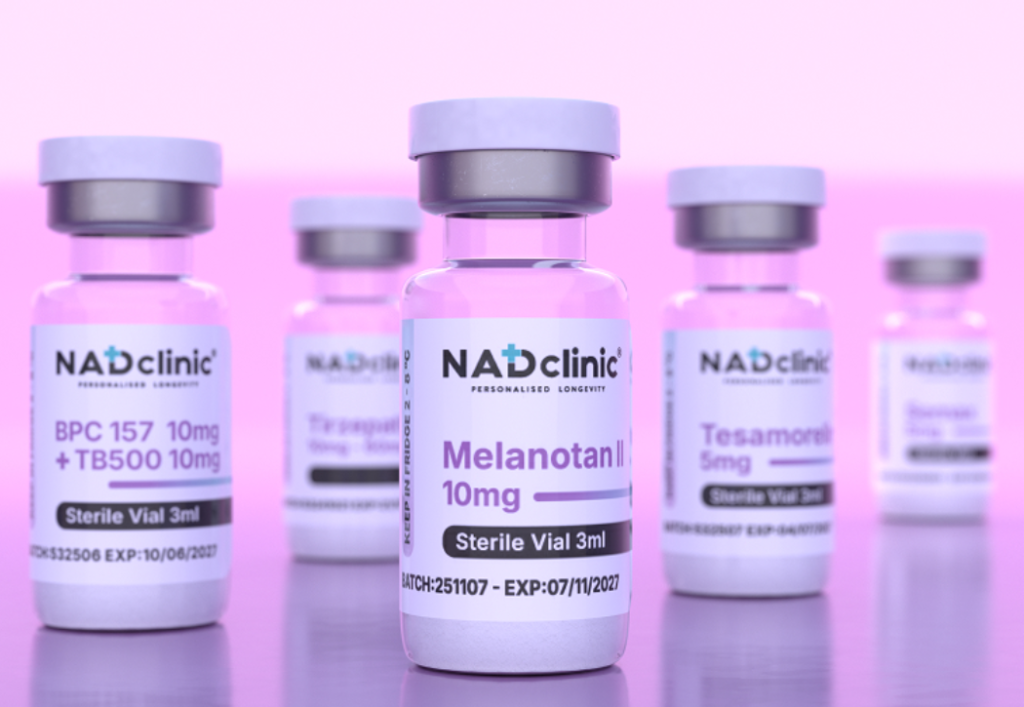
end up being used subcutaneously, intranasally, or intravenously despite not being authorized as medications. And here appear the real risks: unknown purity
- contamination
- molecular sequence errors
- counterfeit products
- absence of GMP controls
- incorrect dosages
- degradation due to poor storage
- lack of pharmacovigilance
- Because two vials labeled as "BPC-157" can contain different molecules, different concentrations, or even not contain the advertised compound. For this, the guarantee of the pharmaceutical laboratory and its standards are essential.
How to know if a peptide is authorized in Europe.
This is probably the most important question for doctors, clinics, and patients. And also one of the worst understood. There is no large public list titled "legal and illegal peptides." The European regulatory system works differently.
The central reference is the.
European Medicines Agency, along with the national agencies of each country, such as the Spanish Agency of Medicines and Medical Devices in Spain. The official databases that professionals actually use are:, EMA Medicines Database
- CIMA from the AEMPS.
- There you can check: if a medication is authorized, its official indications, technical data sheet, restrictions, health alerts, prescription conditions. And the result often surprises many users of the biohacker ecosystem:.
a large part of the most popular peptides on social media do not appear authorized as medications in Europe. Europe maintains a much more conservative position than the United States regarding advanced peptide medicine. While in the US the compounding and longevity ecosystem has grown enormously over the last decade, European regulation requires:.
formal authorization
- solid clinical evidence
- pharmaceutical control
- That is why many compounds widely used in international biohacking clinics operate within a huge gray area when they reach the European environment. And here appears another great confusion:
- traceability
- and formal medical prescription.
being able to buy a peptide online does not mean it can be used legally in clinical practice. being able to buy a peptide online does not mean it can be legally used in clinical practice.
What can happen if a doctor prescribes an unauthorized peptide
This is the most delicate point of the entire debate. Because not every use outside the approved label automatically constitutes a crime. But not everything is allowed either. There is a huge difference between:
- off-label use
- magistral formulation
- compassionate use
- clinical research
- and administration of unauthorized substances
In medicine it is relatively common to use authorized medications outside their original indications when there is clinical judgment and reasonable evidence. This has occurred for years with numerous metabolic and hormonal drugs. But even in those cases:
- there must be medical justification
- informed consent
- regulated manufacturing
- clinical documentation
- and professional responsibility.
If the compound: has no European authorization, is not part of a clinical trial, does not fit within exceptional pathways, and cannot be legally justified, the scenario changes radically. A doctor could be exposed to:
- administrative sanctions
- civil claims
- professional board issues
- loss of insurance coverage
- professional liability
- and even criminal consequences if there is harm or illegal marketing.
Particularly sensitive is:
- importing clandestine products
- selling them directly
- promoting them with medical claims
- administering them in spas, hotels, or unauthorized centers
- or using “research” products officially intended for laboratory use.
The patient's signed consent does not automatically make a practice legal and many professionals still mistakenly believe it does.
A large part of the current problem stems from social media. Influencers, biohackers, commercial affiliates, and supposed experts have transformed complex molecules into aspirational products associated with: rejuvenation, hyperproductivity, fat loss, muscle, energy, recovery, hormonal optimization.
The narrative often greatly simplifies a much more uncertain scientific reality. Some peptides show promising results. Others have only preliminary animal studies. And many still lack solid long-term safety data in humans.
How to navigate without ending up deceived — or worse
Truly serious professionals in the sector typically analyze five factors before working with any peptide:
- real scientific evidence
- regulatory status
- pharmaceutical quality
- manufacturer traceability
- documented clinical experience.
Because today the real problem is no longer access to peptides, access is almost unlimited, the difficulty lies in distinguishing:
- science from marketing
- medicine from business
- innovation from improvisation
- and legitimate clinical practice from a gray market disguised as advanced longevity.
In a scenario where a new molecule presented as “revolutionary” appears every week, the difference between a serious professional and a sophisticated seller begins precisely there: in knowing not only what a peptide promises, but also what can legally be done with it.
Stock photos, public, royalty-free.