The science of wellness is entering a new dimension. Researchers at Oxford University have developed a type of fluorescent protein capable of responding not only to light, but also to magnetic fields and radio waves. A breakthrough that, although born in the laboratory, could transform the way we understand - and measure - human ageing.
The study, published in Nature, enter the calls magnetosensitive fluorescent proteins (MFPs), The new technology, an innovation that unites biology, quantum physics and advanced measurement technology. Its potential goes far beyond scientific imaging: it opens the door to new tools for observing internal body processes that were hitherto virtually invisible.

Beyond “seeing”: starting to measure the biology of ageing
For decades, fluorescent proteins have allowed science to “light up” cellular processes: to show when a gene is activated or where a particular molecule is located. However, these signals rely exclusively on light, which limits their use in deep tissue or complex biological environments.
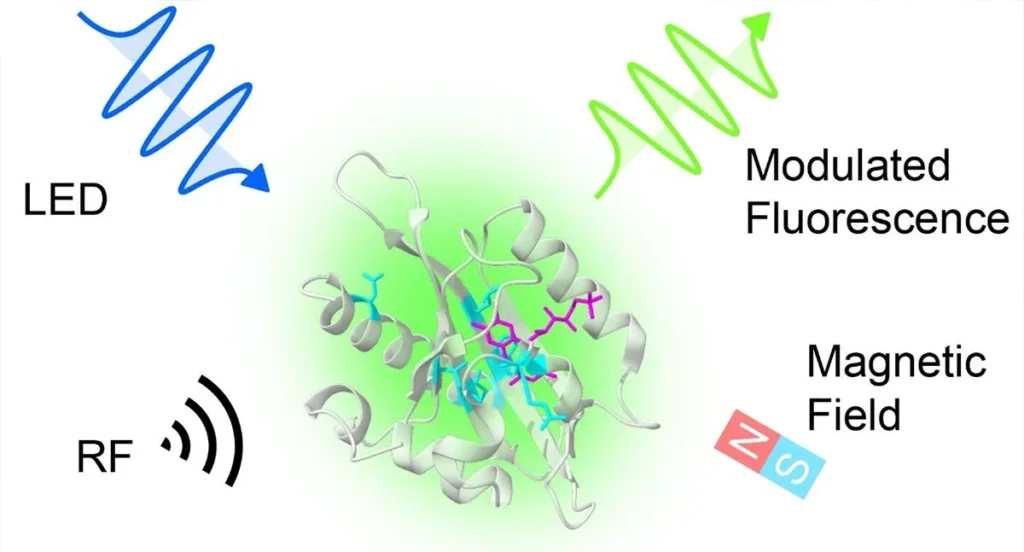
The new MFPs retain that light capability, but add something radically different: their fluorescence can be modulated by magnetic and radio frequency fields. Simply put, these proteins don't just glow, they “respond” to the physical environment around them.
Why is this relevant to wellness and longevity? Because ageing does not occur uniformly or visibly. It is a silent, local process that is highly dependent on the cellular microenvironment: oxidative stress, inflammation, metabolic imbalances or free radical accumulation.
Measuring these factors accurately has, until now, been one of the great challenges of geroscience.
Living sensors to understand the internal state of the body
This breakthrough suggests a future in which proteins will act as active biological sensors, The new technology is capable of providing information on the real state of the tissues, not only on their structure.
MFPs can detect changes in the cell's immediate environment, including the presence of paramagnetic molecules, alterations in redox balance or magnetic “noise” generated by metabolic processes. In other words, they could help identify early signs of cell deterioration before clinical symptoms appear.
In the context of welfare, this points to a clear evolution from a reactive approach to a predictive and personalised wellbeing, where internal measurement is as important as external lifestyle.
Longevity based on real data, not on assumptions
One of the big problems in the longevity industry is the difficulty of proving which interventions really work. Diets, supplements, light therapy, cold therapy, exercise or biohacking all promise benefits, but their effects on specific cells and at the right time are rarely measured.
This type of technology could become a key part of validating longevity therapies, allowing us to observe how the body responds to a particular intervention, in real time and at a microscopic level.
It is no coincidence that leading longevity companies are increasingly investing not only in treatments, but in advanced measurement tools. For without reliable data, welfare risks becoming an aspirational promise rather than an applied science.
When evolution trumps human design
Interestingly, these proteins were not designed from scratch. The researchers used targeted development, The process mimics natural selection in the laboratory, allowing biology itself to find solutions that human engineering does not yet know how to create.
This approach reinforces a key idea in integrative wellness: the body is not a machine that fits with screws, but a complex, intelligent and adaptive system. Understanding it requires listening to its signals, not imposing simplified models.
Towards a new generation of silent diagnostics
Although we are still a long way from clinical or commercial wellness applications, researchers have already tested a fascinating concept: a kind of “magnetic resonance-type fluorescence”.”, The new technology, capable of locating biological signals beyond the limitations of traditional light.
In the future, this could lead to non-invasive diagnostic technologies capable of assessing the internal state of tissues without the need for aggressive procedures.
The welfare of the future will either be measurable or it will not.
This breakthrough marks a paradigm shift. Well-being is no longer defined just by how we feel, but by what happens in our internal systems: cellular energy, metabolic balance, stress resilience and regenerative capacity.
Magnetosensitive proteins are not a fad or a futuristic gadget. They are a clear sign of where the science of wellness is heading: measure to understand, understand to intervene and intervene with precision.
In the age of longevity, three concepts become essential: signal, context and evidence. And for the first time, biology seems to be learning to speak to us in that language.