Clinical research is accumulating increasingly solid evidence on the antidepressant potential of psilocybin, especially in people with treatment-resistant depression. Australia allows its use under highly restricted conditions, and Oregon has created a regulated psychedelic services system. In Spain, its therapeutic use remains limited to authorized research.
For decades, psilocybin was associated with psychedelic culture and recreational use. Psychiatry's interest in this substance, however, has a considerably older history. During the 1950s and 1960s, some of the first clinical experiments with psychedelics were conducted before regulatory restrictions brought virtually all research to a halt for several decades.
The situation began to shift at the end of the 20th century and, much more visibly, over the past fifteen years. Universities, hospitals, and pharmaceutical companies have resumed the study of psilocybin using methods consistent with modern clinical research. The results obtained so far explain why the substance has come to occupy a relevant place in the debate about the future of depression treatments.
A meta-analysis published in 2025 in Acta Psychiatrica Scandinavica, which pooled six randomized clinical trials and 427 participants, found a reduction in depressive symptoms significantly greater than that observed in control groups. The likelihood of clinical response was approximately 3.4 times higher, and the likelihood of remission 3.7 times higher, among patients treated with psilocybin.
The results are especially interesting in patients with treatment-resistant depression, a group in which therapeutic options can be limited after several pharmacological and psychotherapeutic treatments without an adequate response.
The session lasts hours and requires supervision
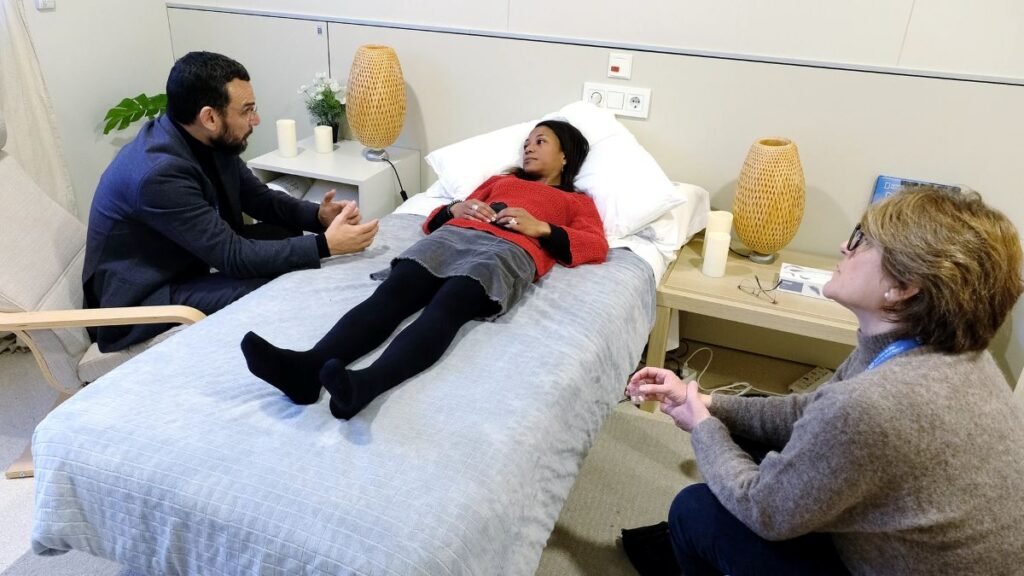
Clinical protocols have little in common with the image of someone taking psilocybin at home to improve their mood. The substance is administered at a specific dose, within a prepared setting, and after a medical and psychological evaluation. The patient remains accompanied for several hours while the acute effect lasts, and subsequently attends sessions aimed at processing and integrating the experience.
Prior preparation plays an important role. The therapeutic team explains what the patient may experience, reviews their medical and psychiatric history, analyzes the medication they are taking, and establishes the necessary conditions for the session to take place safely.
During administration, the person may experience very intense alterations in perception, sense of time, and sense of self, as well as emotional and cognitive changes. The duration and intensity depend on the dose and individual characteristics, but clinical sessions require several hours precisely because the effect does not wear off quickly.
The follow-up work completes the protocol. Integration sessions allow the patient to review what happened and connect it to the psychological issues that led them to treatment.
This structure also explains why researchers usually speak of psilocybin-assisted therapy rather than simply pharmacological treatment with psilocybin.
Debate still exists over the exact contribution of each element. Psilocybin produces significant neurobiological and subjective changes, while the therapeutic context can influence how those changes translate into modifications in behavior, emotions, and certain thought patterns.
Australia: psilocybin within a medical protocol
Australia offers one of the most advanced examples of clinical regulation.
Since July 2023, certain psychiatrists can use psilocybin for patients with treatment-resistant depression under the Authorised Prescriber scheme of the Therapeutic Goods Administration. The system requires specific authorization and supervision within a clinical protocol. Psilocybin remains a medicine not approved by the TGA for general marketing.
The intervention requires an appropriate clinical setting and trained professionals to accompany the patient. Administration also does not follow the pattern of a conventional prescription: the patient does not simply receive a medication to take at home.
During 2026, Australia introduced some changes to the conditions regulating these treatments, including aspects related to medical supervision and the composition of therapeutic teams. The framework remains restrictive and is primarily aimed at patients with severe conditions resistant to available treatments.
The Australian model is relevant because it represents one of the first occasions on which a national regulator has allowed a psychedelic to be used clinically for a specific psychiatric indication under the responsibility of authorized specialists.

Oregon has created another model
In the United States, the situation requires more careful explanation because there are significant differences between federal legislation and certain state programs.
Oregon has allowed since 2023 the so-called psilocybin services. People over 21 can access them without a medical prescription or a depression diagnosis, but they must complete a preparation session and an administration session at a licensed center, followed by an integration phase.
The system has a particularly relevant feature: psilocybin is consumed within the facility and cannot be legally purchased to take home. During the session, the user remains accompanied by a licensed facilitator.
This model also does not amount to an FDA pharmacological approval of psilocybin for depression. Oregon's state regulation and U.S. federal legislation operate on different levels.
For that reason, when talking about the United States, it's important to distinguish between clinical trials studying psilocybin as a medication and Oregon's psychedelic services program, which responds to specific state legislation.
Spain keeps the substance under control
Spain holds a far more active position in psychedelic research than its regulatory situation might suggest. Psilocybin and psilocin are listed in Schedule I of psychotropic substances under control in Spain, according to Royal Decree 2829/1977, meaning their use, manufacturing, distribution, prescription, and possession are subject to a specific control regime; this does not, however, prevent their use within authorized clinical research.
The most developed case is found at the Parc Sanitari Sant Joan de Déu, in Barcelona, where the ANIMA research group has been working with psychedelics and treatment-resistant depression for several years. The center conducted two phase II trials with psilocybin in 2021 and subsequently expanded this line with studies incorporating psilocybin and 5-MeO-DMT, in collaboration with companies such as Compass Pathways, Beckley Psytech, and GH Research.
In these protocols, administration takes place in a controlled hospital setting, accompanied by psychotherapeutic support and with follow-up afterward, and not as a prescription the patient can take home. Spanish research has also been integrated into the international phase III program of COMP360, the psilocybin formulation developed by Compass Pathways for treatment-resistant depression: the NCT05711940 trial, with 572 participants, included Spanish centers such as Hospital Clínic de Barcelona, Parc Sanitari Sant Joan de Déu, Hospital Universitario Fundación Jiménez Díaz in Madrid, FIDMAG Hermanas Hospitalarias, Hospital Universitario Río Hortega in Valladolid, and Hospital Provincial de Zamora, among other international centers.
The study compares administrations of 25, 10, and 1 mg of COMP360 alongside psychological support and includes follow-up of up to 52 weeks. This activity makes it possible to state that psilocybin is already being administered to patients with depression in Spain within certain clinical trials, but not that a psilocybin therapy is yet available as a conventional medical treatment: outside an authorized study, a Spanish psychiatrist cannot simply prescribe psilocybin for a patient to consume at home or administer it as standard treatment in a private practice.
The difference is fundamental. Spain is participating in generating the evidence that could support a future authorization, but, as of September 2026, psilocybin remains an investigational product and not an authorized medication for treating depression in ordinary clinical practice.
Why might it work?
Psilocybin is transformed into psilocin once ingested. This molecule acts primarily on 5-HT2A serotonergic receptors, which are involved in processes related to perception, cognition, and emotional regulation.
The biological explanation for the antidepressant effect is still being investigated. One of the most studied hypotheses links the psychedelic experience to transient changes in certain brain circuits and to an increase in neuronal and psychological plasticity.
During the experience, certain rigid and repetitive thought patterns may temporarily decrease. In people with depression, this could facilitate a revision of certain negative associations, memories, and emotional patterns that have persisted over long periods.
Research on neuroplasticity has generated particular interest because it offers a possible explanation for the speed with which some patients improve after one or two sessions. Conventional antidepressants usually need several weeks to reach their full therapeutic effect, while some psilocybin trials have observed significant changes just days after administration.
The hypothesis still needs confirmation. Researchers have also not determined how much the outcome depends on the pharmacological action and how much on the subjective experience and therapeutic context.
The numbers are promising, but not uniform
One of the first controlled trials to spark considerable interest was conducted by researchers at Johns Hopkins in patients with major depression. Two psilocybin sessions accompanied by psychological support produced a clinical response in 71% of participants and remission in 54% at four weeks. The small sample size requires interpreting these percentages with caution.
Subsequent work has expanded the evidence base. The meta-analysis published in 2025 confirmed a significant antidepressant effect and a higher likelihood of response and remission compared with controls. Other analyses have found similar results, although with important differences between studies related to doses, patient type, comparators, and session design.
One of the best-known methodological difficulties in psychedelic research is blinding. A person receiving a sufficiently high dose of psilocybin usually perceives that they have received an active substance, which makes it difficult to keep the trial fully blinded. Patient expectations can influence their perception of effects and certain subjective measures.
The most recent studies are trying to reduce this problem through more sophisticated designs and active control groups.
The leap toward phase III trials
Research has also entered a much more advanced stage with pharmaceutical development programs from companies such as Compass Pathways.
Its compound COMP360, a synthetic formulation of psilocybin, has been studied in phase III trials for treatment-resistant depression. In 2026, the company reported positive results from its second pivotal trial, with a clinically relevant reduction in symptoms in a significant proportion of patients treated with 25 mg.
Data reported by the company indicate that approximately 39% of patients who received 25 mg met the study-defined response criterion at week six, and that part of the benefit persisted during subsequent follow-up.
These results still need to be interpreted within the context of an ongoing pharmaceutical development program and the full data that will need to be evaluated by regulators. Even so, the fact that research has reached phase III marks a substantial difference from the early exploratory studies conducted with very small samples.
Interest from health authorities has also increased. The FDA has introduced measures aimed at accelerating the development of psychedelic treatments for serious mental illness, within a broader context of research into new therapeutic alternatives.
The risks require careful patient selection
The safety profile observed in clinical trials has been reasonably favorable when participants have been selected according to strict criteria and sessions have been conducted under supervision.
The most common adverse effects include headache, nausea, dizziness, anxiety, and transient increases in blood pressure and heart rate. Intense perceptual alterations and episodes of fear or distress may also occur during the experience.
Prior patient selection is especially important in this treatment. Protocols usually exclude people with certain histories of psychosis, certain bipolar disorders, or other conditions that may increase the risk of an adverse psychiatric reaction.
The difference between a supervised clinical session and psilocybin use outside a healthcare setting is especially relevant at this point. In a trial, the dose is defined, the substance is characterized, the patient has been evaluated, and trained staff are available to intervene. In unregulated use, all of those elements may be missing.
Nor do we yet know with the same depth the possible effects of repeated exposures over prolonged periods. The trials conducted so far provide important information on the safety of specific protocols, but they do not allow extrapolating their results to any form of use.
The treatment is expensive because it requires professional time
Cost is another obstacle to the expansion of this type of therapy.
In Spain, there is no official therapeutic price because psilocybin is not authorized as a medication for depression. Any figure attributed to a supposed “price of psilocybin treatment in Spain” would necessarily mix legal models with unregulated offerings.
Oregon offers a more useful reference because a legal market for psychedelic services exists. Prices depend on each center and can vary considerably, although available estimates place many complete sessions at roughly between $1,000 and $3,500.
Most of the cost does not correspond to the substance. A session requires hours of professional presence, adequate facilities, prior preparation, and subsequent follow-up. The treatment requires a much more time-intensive infrastructure than the conventional dispensing of an antidepressant.
This characteristic will matter if psilocybin obtains pharmaceutical approval. The economic model of a therapy requiring several hours of supervision and specialized professionals will necessarily differ from that of a medication a patient picks up at a pharmacy and takes daily.
A possible new tool for treatment-resistant depression
Research on psilocybin has reached a point where it is difficult to consider the phenomenon a passing fad. There are controlled trials, meta-analyses, phase III programs, and two countries that have developed regulatory frameworks to allow certain forms of use.
At the same time, important questions remain unanswered. It remains to be determined which patients are most likely to respond, how long improvement can be maintained, what the optimal dose is, how many sessions are needed, and what exact role psychotherapy plays.
It will also be necessary to determine how a treatment of this nature would fit within healthcare systems. An intervention lasting several hours, accompanied by professionals and followed by integration sessions, requires very different resources from those needed to prescribe a conventional antidepressant.
The available research allows us to speak of considerable therapeutic potential, especially for people with treatment-resistant depression, but it is still premature to present psilocybin as a general solution for depression.
The scenario taking shape is more specific and, probably, more interesting: a treatment in which a carefully dosed psychedelic substance can open a temporary window of psychological change, while the clinical setting and therapeutic work help the patient make the most of it.
Australia has decided to allow that model under a highly restricted medical framework. Oregon has built an alternative based on regulated psychedelic services. Europe continues to study the substance within the limits of clinical research. Spain, for now, keeps psilocybin under control and outside routine clinical practice.
The results of the large trials now emerging will be decisive. If they confirm the benefits observed in previous research, regulators will have to decide not only whether to authorize the molecule, but also how it should be administered, who may do so, and what role psychotherapy should play within the treatment.
Key scientific studies:
https://www.bmj.com/content/385/bmj-2023-078084
https://jamanetwork.com/journals/jamanetworkopen/fullarticle/2849099