Clinical research is accumulating increasingly solid evidence on the antidepressant potential of psilocybin, especially in people with treatment-resistant depression. Australia allows its use under highly restricted conditions, and Oregon has created a regulated psychedelic services system. In Spain, its therapeutic use remains limited to authorized research.
For decades, psilocybin was associated with psychedelic culture and recreational use. Psychiatry's interest in this substance, however, has a considerably older history. During the 1950s and 1960s, some of the first clinical experiments with psychedelics were conducted before regulatory restrictions brought virtually all research to a halt for several decades.
The situation began to shift at the end of the 20th century and, much more visibly, over the past fifteen years. Universities, hospitals, and pharmaceutical companies have resumed the study of psilocybin using methods consistent with modern clinical research. The results obtained so far explain why the substance has come to occupy a relevant place in the debate about the future of depression treatments.
A meta-analysis published in 2025 in Acta Psychiatrica Scandinavica, which pooled six randomized clinical trials and 427 participants, found a reduction in depressive symptoms significantly greater than that observed in control groups. The likelihood of clinical response was approximately 3.4 times higher, and the likelihood of remission 3.7 times higher, among patients treated with psilocybin.
The results are especially interesting in patients with treatment-resistant depression, a group in which therapeutic options can be limited after several pharmacological and psychotherapeutic treatments without an adequate response.
The session lasts hours and requires supervision
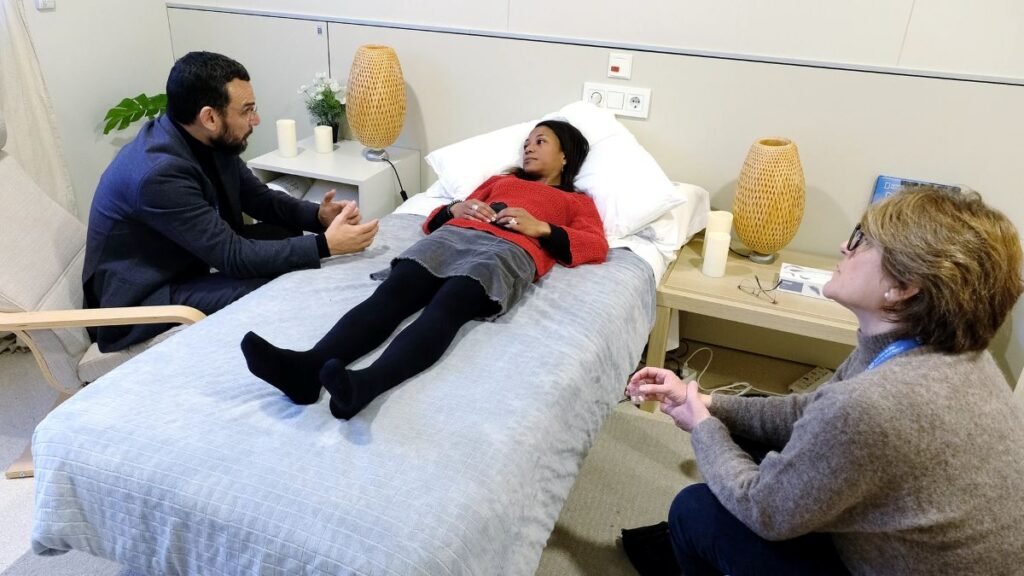
Clinical protocols have little in common with the image of someone taking psilocybin at home to improve their mood. The substance is administered at a specific dose, within a prepared setting, and after a medical and psychological evaluation. The patient remains accompanied for several hours while the acute effect lasts, and subsequently attends sessions aimed at processing and integrating the experience.
Prior preparation plays an important role. The therapeutic team explains what the patient may experience, reviews their medical and psychiatric history, analyzes the medication they are taking, and establishes the necessary conditions for the session to take place safely.
During administration, the person may experience very intense alterations in perception, sense of time, and sense of self, as well as emotional and cognitive changes. The duration and intensity depend on the dose and individual characteristics, but clinical sessions require several hours precisely because the effect does not wear off quickly.
The follow-up work completes the protocol. Integration sessions allow the patient to review what happened and connect it to the psychological issues that led them to treatment.
This structure also explains why researchers usually speak of psilocybin-assisted therapy rather than simply pharmacological treatment with psilocybin.
Debate still exists over the exact contribution of each element. Psilocybin produces significant neurobiological and subjective changes, while the therapeutic context can influence how those changes translate into modifications in behavior, emotions, and certain thought patterns.
Australia: psilocybin within a medical protocol
Australia offers one of the most advanced examples of clinical regulation.
Since July 2023, certain psychiatrists can use psilocybin for patients with treatment-resistant depression under the Authorised Prescriber scheme of the Therapeutic Goods Administration. The system requires specific authorization and supervision within a clinical protocol. Psilocybin remains a medicine not approved by the TGA for general marketing.
The intervention requires an appropriate clinical setting and trained professionals to accompany the patient. Administration also does not follow the pattern of a conventional prescription: the patient does not simply receive a medication to take at home.
During 2026, Australia introduced some changes to the conditions regulating these treatments, including aspects related to medical supervision and the composition of therapeutic teams. The framework remains restrictive and is primarily aimed at patients with severe conditions resistant to available treatments.
The Australian model is relevant because it represents one of the first occasions on which a national regulator has allowed a psychedelic to be used clinically for a specific psychiatric indication under the responsibility of authorized specialists.

Oregon has created another model
In the United States, the situation requires more careful explanation because there are significant differences between federal legislation and certain state programs.
Oregon has allowed since 2023 the so-called psilocybin services. People over 21 can access them without a medical prescription or a depression diagnosis, but they must complete a preparation session and an administration session at a licensed center, followed by an integration phase.
The system has a particularly relevant feature: psilocybin is consumed within the facility and cannot be legally purchased to take home. During the session, the user remains accompanied by a licensed facilitator.
This model also does not amount to an FDA pharmacological approval of psilocybin for depression. Oregon's state regulation and U.S. federal legislation operate on different levels.
For that reason, when talking about the United States, it's important to distinguish between clinical trials studying psilocybin as a medication and Oregon's psychedelic services program, which responds to specific state legislation.
Spain keeps the substance under control
Spain holds a far more active position in psychedelic research than its regulatory situation might suggest. Psilocybin and psilocin are listed in Schedule I of psychotropic substances under control in Spain, according to Royal Decree 2829/1977, meaning their use, manufacturing, distribution, prescription, and possession are subject to a specific control regime; this does not, however, prevent their use within authorized clinical research.
The most developed case is found at the Parc Sanitari Sant Joan de Déu, in Barcelona, where the ANIMA research group has been working with psychedelics and treatment-resistant depression for several years. The center conducted two phase II trials with psilocybin in 2021 and subsequently expanded this line with studies incorporating psilocybin and 5-MeO-DMT, in collaboration with companies such as Compass Pathways, Beckley Psytech, and GH Research.
In these protocols, administration takes place in a controlled hospital setting, accompanied by psychotherapeutic support and with follow-up afterward, and not as a prescription the patient can take home. Spanish research has also been integrated into the international phase III program of COMP360, the psilocybin formulation developed by Compass Pathways for treatment-resistant depression: the NCT05711940 trial, with 572 participants, included Spanish centers such as Hospital Clínic de Barcelona, Parc Sanitari Sant Joan de Déu, Hospital Universitario Fundación Jiménez Díaz in Madrid, FIDMAG Hermanas Hospitalarias, Hospital Universitario Río Hortega in Valladolid, and Hospital Provincial de Zamora, among other international centers.
The study compares administrations of 25, 10, and 1 mg of COMP360 alongside psychological support and includes follow-up of up to 52 weeks. This activity makes it possible to state that psilocybin is already being administered to patients with depression in Spain within certain clinical trials, but not that a psilocybin therapy is yet available as a conventional medical treatment: outside an authorized study, a Spanish psychiatrist cannot simply prescribe psilocybin for a patient to consume at home or administer it as standard treatment in a private practice.
The difference is fundamental. Spain is participating in generating the evidence that could support a future authorization, but, as of September 2026, psilocybin remains an investigational product and not an authorized medication for treating depression in ordinary clinical practice.
Why might it work?
Psilocybin is transformed into psilocin once ingested. This molecule acts primarily on 5-HT2A serotonergic receptors, which are involved in processes related to perception, cognition, and emotional regulation.
The biological explanation for the antidepressant effect is still being investigated. One of the most studied hypotheses links the psychedelic experience to transient changes in certain brain circuits and to an increase in neuronal and psychological plasticity.
During the experience, certain rigid and repetitive thought patterns may temporarily decrease. In people with depression, this could facilitate a revision of certain negative associations, memories, and emotional patterns that have persisted over long periods.
Research on neuroplasticity has generated particular interest because it offers a possible explanation for the speed with which some patients improve after one or two sessions. Conventional antidepressants usually need several weeks to reach their full therapeutic effect, while some psilocybin trials have observed significant changes just days after administration.
The hypothesis still needs confirmation. Researchers have also not determined how much the outcome depends on the pharmacological action and how much on the subjective experience and therapeutic context.
The numbers are promising, but not uniform
One of the first controlled trials to spark considerable interest was conducted by researchers at Johns Hopkins in patients with major depression. Two psilocybin sessions accompanied by psychological support produced a clinical response in 71% of participants and remission in 54% at four weeks. The small sample size requires interpreting these percentages with caution.
Los trabajos posteriores han ampliado la evidencia. El metaanálisis publicado en 2025 confirmó un efecto antidepresivo significativo y una mayor probabilidad de respuesta y remisión frente a los controles. Otros análisis han encontrado resultados similares, aunque con diferencias importantes entre estudios relacionadas con las dosis, el tipo de pacientes, los comparadores y el diseño de las sesiones.
Una de las dificultades metodológicas más conocidas de la investigación psicodélica es el cegamiento. Una persona que recibe una dosis suficientemente alta de psilocibina suele percibir que ha recibido una sustancia activa, lo que dificulta mantener completamente ciego el ensayo. Las expectativas del paciente pueden influir en su percepción de los efectos y en determinadas medidas subjetivas.
Los estudios más recientes están intentando reducir este problema mediante diseños más sofisticados y grupos de control activos.
El salto hacia los ensayos de fase III
La investigación ha entrado además en una etapa mucho más avanzada con los programas de desarrollo farmacéutico de compañías como Compass Pathways.
Su compuesto COMP360, una formulación sintética de psilocibina, ha sido estudiado en ensayos de fase III en depresión resistente. En 2026, la compañía comunicó resultados positivos de su segundo ensayo pivotal, con una reducción clínicamente relevante de los síntomas en una proporción significativa de los pacientes tratados con 25 mg.
Los datos comunicados por la compañía indican que aproximadamente el 39% de los pacientes que recibieron 25 mg alcanzó el criterio de respuesta definido en el estudio en la semana seis y que parte del beneficio permaneció durante el seguimiento posterior.
Estos resultados todavía deben interpretarse dentro del contexto de un programa de desarrollo farmacéutico en curso y de los datos completos que deberán ser evaluados por los reguladores. Aun así, el hecho de que la investigación haya llegado a fase III marca una diferencia sustancial respecto a los primeros estudios exploratorios realizados con muestras muy pequeñas.
El interés de las autoridades sanitarias también ha aumentado. La FDA ha introducido medidas destinadas a acelerar el desarrollo de tratamientos psicodélicos para enfermedades mentales graves, dentro de un contexto más amplio de investigación de nuevas alternativas terapéuticas.
Los riesgos obligan a seleccionar cuidadosamente al paciente
El perfil de seguridad observado en los ensayos clínicos ha sido razonablemente favorable cuando los participantes han sido seleccionados siguiendo criterios estrictos y las sesiones se han desarrollado bajo supervisión.
Los efectos adversos más habituales incluyen cefalea, náuseas, mareo, ansiedad y aumentos transitorios de la presión arterial y de la frecuencia cardíaca. También pueden aparecer alteraciones perceptivas intensas y episodios de miedo o angustia durante la experiencia.
La selección previa del paciente resulta especialmente importante en este tratamiento. Los protocolos excluyen habitualmente a personas con determinados antecedentes de psicosis, determinados trastornos bipolares u otras condiciones que puedan aumentar el riesgo de una reacción psiquiátrica adversa.
La diferencia entre una sesión clínica supervisada y el consumo de psilocibina fuera de un entorno sanitario resulta especialmente relevante en este punto. En un ensayo, la dosis está definida, la sustancia está caracterizada, el paciente ha sido evaluado y existe personal preparado para intervenir. En el consumo no regulado pueden faltar todos esos elementos.
Tampoco conocemos todavía con la misma profundidad los posibles efectos de exposiciones repetidas durante periodos prolongados. Los ensayos realizados hasta ahora proporcionan información importante sobre la seguridad de determinados protocolos, pero no permiten extrapolar sus resultados a cualquier forma de consumo.
El tratamiento es caro porque requiere tiempo profesional
El precio constituye otro de los obstáculos para la expansión de este tipo de terapia.
En España no existe un precio terapéutico oficial porque la psilocibina no está autorizada como medicamento para la depresión. Cualquier cifra atribuida a un supuesto “precio del tratamiento con psilocibina en España” mezclaría necesariamente modelos legales con ofertas no reguladas.
Oregón ofrece una referencia más útil porque existe un mercado legal de servicios psicodélicos. Los precios dependen de cada centro y pueden variar considerablemente, aunque las estimaciones disponibles sitúan muchas sesiones completas aproximadamente entre 1.000 y 3.500 dólares.
La mayor parte del coste no corresponde a la sustancia. Una sesión requiere horas de presencia profesional, instalaciones adecuadas, preparación previa y seguimiento posterior. El tratamiento exige una infraestructura mucho más intensiva en tiempo que la dispensación convencional de un antidepresivo.
Esta característica tendrá importancia si la psilocibina llega a obtener una autorización farmacéutica. El modelo económico de una terapia que requiere varias horas de supervisión y profesionales especializados será necesariamente diferente del de un medicamento que el paciente recoge en una farmacia y toma diariamente.
Una posible nueva herramienta para la depresión resistente
La investigación sobre psilocibina ha alcanzado un punto en el que resulta difícil considerar el fenómeno una simple moda pasajera. Existen ensayos controlados, metaanálisis, programas de fase III y dos países que han desarrollado marcos regulatorios para permitir determinadas formas de utilización.
Al mismo tiempo, quedan preguntas importantes por responder. Falta determinar qué pacientes presentan una mayor probabilidad de respuesta, cuánto tiempo puede mantenerse la mejoría, cuál es la dosis óptima, cuántas sesiones son necesarias y qué papel exacto desempeña la psicoterapia.
También habrá que determinar cómo encajaría un tratamiento de estas características dentro de los sistemas sanitarios. Una intervención de varias horas, acompañada por profesionales y seguida de sesiones de integración, requiere recursos muy diferentes de los que necesita la prescripción de un antidepresivo convencional.
La investigación disponible permite hablar de un potencial terapéutico considerable, especialmente para personas con depresión resistente, pero todavía resulta prematuro presentar la psilocibina como una solución general para la depresión.
El escenario que se está dibujando es más específico y, probablemente, más interesante: un tratamiento en el que una sustancia psicodélica cuidadosamente dosificada puede abrir una ventana temporal de cambio psicológico, mientras el entorno clínico y el trabajo terapéutico ayudan al paciente a aprovecharla.
Australia ha decidido permitir ese modelo bajo un régimen médico muy restringido. Oregón ha construido una alternativa basada en servicios psicodélicos regulados. Europa continúa estudiando la sustancia dentro de los límites de la investigación clínica. España, por el momento, mantiene la psilocibina bajo fiscalización y fuera de la práctica asistencial ordinaria.
Los resultados de los grandes ensayos que están llegando ahora serán determinantes. Si confirman los beneficios observados en las investigaciones anteriores, los reguladores tendrán que decidir no solamente si autorizan la molécula, sino también cómo debe administrarse, quién puede hacerlo y qué lugar debe ocupar la psicoterapia dentro del tratamiento.
Estudios científicos de referencia:
https://www.bmj.com/content/385/bmj-2023-078084
https://jamanetwork.com/journals/jamanetworkopen/fullarticle/2849099