For much of the 20th century, lactate occupied an uncomfortable place in exercise physiology. Its rise in blood and muscle coincided with higher-intensity efforts, with the burning sensation and the progressive loss of performance, so much so that for years it was interpreted as a kind of metabolic waste that the body needed to eliminate as quickly as possible.
Exercise physiology has substantially changed that interpretation. Lactate is not a byproduct that passively accumulates when oxygen is lacking, but rather a metabolite that the body produces and uses continuously. Today we know it can act as fuel, as a metabolic intermediary, and also as a signaling molecule.
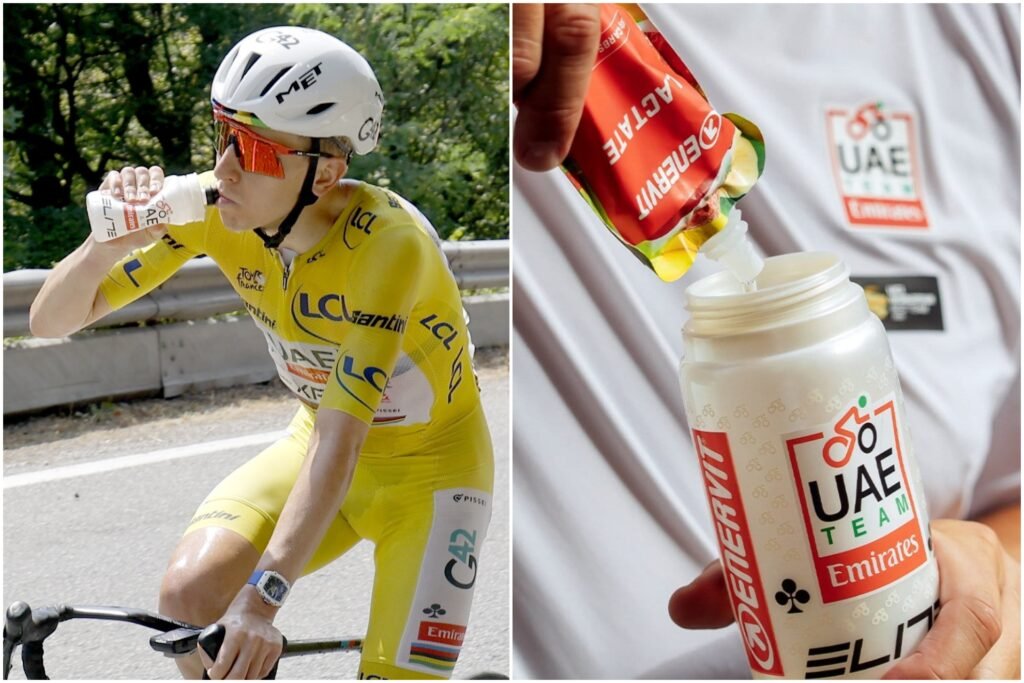
The novelty in 2026 is that this conceptual revision has begun to move from the laboratory to elite-level sport. During the Tour de France, Tadej Pogačar and his UAE Team Emirates-XRG teammates used a new formulation developed alongside Enervit in competition, which incorporates sodium lactate into a carbohydrate-rich drink. The product combines 90 grams of carbohydrates, in a 2:1 ratio of glucose and fructose, with 10 grams of sodium lactate and vitamin B1. The company states that its development spanned two seasons with the riders and the performance team.
Nor is this an isolated case. During the same Tour, a second commercial avenue emerged, ExoLactate, with a different formulation tested by another professional team. The coincidence is significant because it shows that different companies are trying to solve the same question: whether it is possible to incorporate exogenous lactate into the fueling fueling strategy of an endurance athlete and derive a benefit beyond that provided by conventional carbohydrates.
In Spain, Aurora Intelligent Nutrition (AIN) is already working on developing nutritional solutions based on exogenous lactate. The company, specialized in formulating and manufacturing supplements and functional nutritional solutions, is precisely exploring one of the least visible aspects of this new trend: how to incorporate potentially useful amounts of lactate into sports nutrition matrices that maintain adequate stability, functionality, and tolerance during exercise. Its approach still sits in the realm of product development, so its formulations should not be confused with independent clinical validation of lactate's efficacy as a supplement.

From presumed waste to metabolic fuel
The idea underpinning this shift in perspective is more than four decades old. Physiologist George Brooks developed the Lactate Shuttle, theory in the 1980s, according to which lactate acts as an intermediary between energy-producing and energy-consuming tissues. Rather than being trapped in the muscle until exercise ends, it can circulate through the blood and be taken up and oxidized by other tissues.
Subsequent research has considerably expanded this model. Lactate is produced even when sufficient oxygen is available and can be used by oxidative muscle fibers, the heart, and the brain. Under certain physiological circumstances, these tissues can use it preferentially over other substrates.
This distinction matters because it corrects one of the most persistent ideas about exercise: lactate is not responsible for the muscle soreness that appears one or two days after an intense session. The evidence available for decades has ruled out that simplistic explanation.
Nor is it accurate to claim that lactate is, by itself, the cause of all fatigue during intense effort. The relationship between lactate, acidosis, metabolism, and fatigue is far more complex. Muscle acidosis and other metabolic changes can contribute to the loss of strength and power, while lactate can simultaneously perform metabolic and regulatory functions.
The evolution of research has not been limited to energy metabolism. In 2019, a study published in Nature identified histone lactylation, an epigenetic modification derived from lactate metabolism capable of influencing gene expression. The finding opened a new line of research on lactate as a signaling molecule, in addition to being a fuel.
That is where the term lactormone, comes from, used by some researchers to describe its autocrine, paracrine, and endocrine signaling functions. The concept is biologically interesting, although it should not be confused with clinical evidence: the fact that lactate participates in signaling mechanisms does not mean that consuming it as a supplement will automatically reproduce those effects in an athlete.
Does taking lactate actually work?
The answer, as of today, is far less spectacular than some headlines suggest.
There are studies suggesting a possible ergogenic effect. In a randomized trial with 15 physically active people, oral lactate supplementation produced approximately 4% more power during a 20-minute time trial, although it did not alter VO₂ max, ventilatory threshold, or power associated with the lactate threshold. The small sample size requires caution when interpreting the result.
Another study involving 16 trained cyclists used a much larger dose of lactate before an interval test designed to replicate the demands of a road race. Supplementation favorably modified certain acid-base parameters and reduced perceived exertion, but did not produce a significant improvement in performance. Additionally, more gastrointestinal symptoms appeared, including gas, cramps, belching, abdominal pain, and intestinal urgency.
The current balance, therefore, is far more interesting than the idea of a new “superfuel”: there is a solid physiological basis for considering lactate an energy substrate, and there are preliminary signs that its exogenous administration could prove useful during certain efforts, but we still lack sufficient evidence to place it on the same level of certainty as the already established carbohydrate intake strategies.
Enervit's strategy is especially revealing in the way it incorporates lactate. It does not aim to replace carbohydrates, but rather to add another energy source to a strategy fueling that already uses high amounts of glucose and fructose.
The formulation used by UAE Team Emirates-XRG combines 90 grams of carbohydrates with 10 grams of sodium lactate. The company itself explains that the product is designed for the final and most demanding stages of long races, when energy supply becomes especially critical.
Perhaps the most interesting detail is another one: the product is not being used as a universal routine throughout the entire competition. Published information on its use in the Tour points to selective use in stages with high energy demands and to a strategy still being evaluated under real racing conditions.
That nuance matters. The fact that Pogačar uses lactate in competition shows that one of the best performance structures in world cycling considers the strategy promising enough to incorporate it into its nutritional arsenal. It does not prove that the 10 grams of lactate are responsible for his results, nor that the formula will improve the performance of any cyclist.
The real innovation lies in the formulation
The difficulty is not just about having lactate available, but about managing to administer it in potentially useful amounts within a nutritional strategy that the athlete can tolerate during hours of intense exercise.
Gastrointestinal tolerance is one of the obstacles that still appears in the scientific literature. In fact, the available results show that increasing the amount of ingested lactate does not guarantee a proportional improvement in performance and can cause digestive discomfort.
That is why the development of products like Enervit's and the emergence of alternatives such as ExoLactate are relevant even before a definitive conclusion on their efficacy exists. The industry is trying to solve very specific questions around dosage, chemical form, concentration, intestinal transport, combination with carbohydrates, and tolerance during effort.
The next step will be to determine under what circumstances this technology truly offers an advantage over sports nutrition strategies that already work.
Interest in lactate does not, therefore, stem from a sudden fad. The conceptual shift began decades ago, and today there is a solid scientific foundation for understanding it as a dynamic metabolite with energy and signaling functions.
What is genuinely new is the attempt to turn that knowledge into a practical nutritional tool and, above all, to do so in the most demanding environment possible: professional competition.
The presence of lactate at the 2026 Tour de France marks a shift in the landscape, not the end of the scientific debate. The real test will come when different formulations, doses, and administration strategies can be independently compared in sufficiently large trials and, especially, when it can be determined whether improvements observed in the lab consistently translate into time, power, or the ability to sustain performance during a race.
For now, lactate has already ceased to be the metabolic villain it was long believed to be. Whether it becomes an essential tool for endurance athletes is a far more interesting question and, above all, it has sparked the interest of specialized manufacturers like Aurora Intelligent Nutrition, which is working on new sports nutrition matrices with exogenous lactate, while international companies begin bringing their first formulations to the Grand Tours.