Ozone therapy today occupies a unique space in contemporary medicine: a technique with established clinical use in certain contexts, a plausible physiological basis, and, at the same time, heterogeneous scientific evidence that has yet to reach consensus for most of its indications.
Ozone (O₃) is a molecule composed of three oxygen atoms. Biologically, its behavior is radically different from standard medicinal oxygen. In high concentrations and when inhaled, it is toxic to the respiratory epithelium, but in controlled doses administered through specific medical protocols, it has been studied for its ability to induce transient oxidative responses that activate endogenous antioxidant systems.
So-called “medical ozone” is not stored: it is generated on-site from medicinal oxygen using calibrated medical devices. This point is key to understanding its clinical use, as it affects both safety and dose standardization.
Mechanisms of Action: Between Oxidative Biology and Adaptive Response
The interest in ozone therapy in regenerative medicine is based on a specific physiological principle: controlled oxidative stress.
Upon contact with biological fluids, ozone reacts rapidly, forming reactive oxygen species and lipid peroxides in low concentrations. This interaction triggers a cascade of adaptive responses, including:
- activation of antioxidant enzymes (such as superoxide dismutase and catalase)
- modulation of inflammatory mediators
- improvement of tissue microcirculation
- potential effects on local oxygenation
- transient regulation of cellular oxidative stress
This physiological model explains why ozone therapy has sparked interest in areas such as chronic pain, sports medicine, and regenerative medicine. However, biological plausibility does not automatically imply proven clinical efficacy in all its applications.
Routes of Administration and Clinical Applications
Ozone therapy is not a single technique, but a set of procedures with different indications depending on the route of administration.
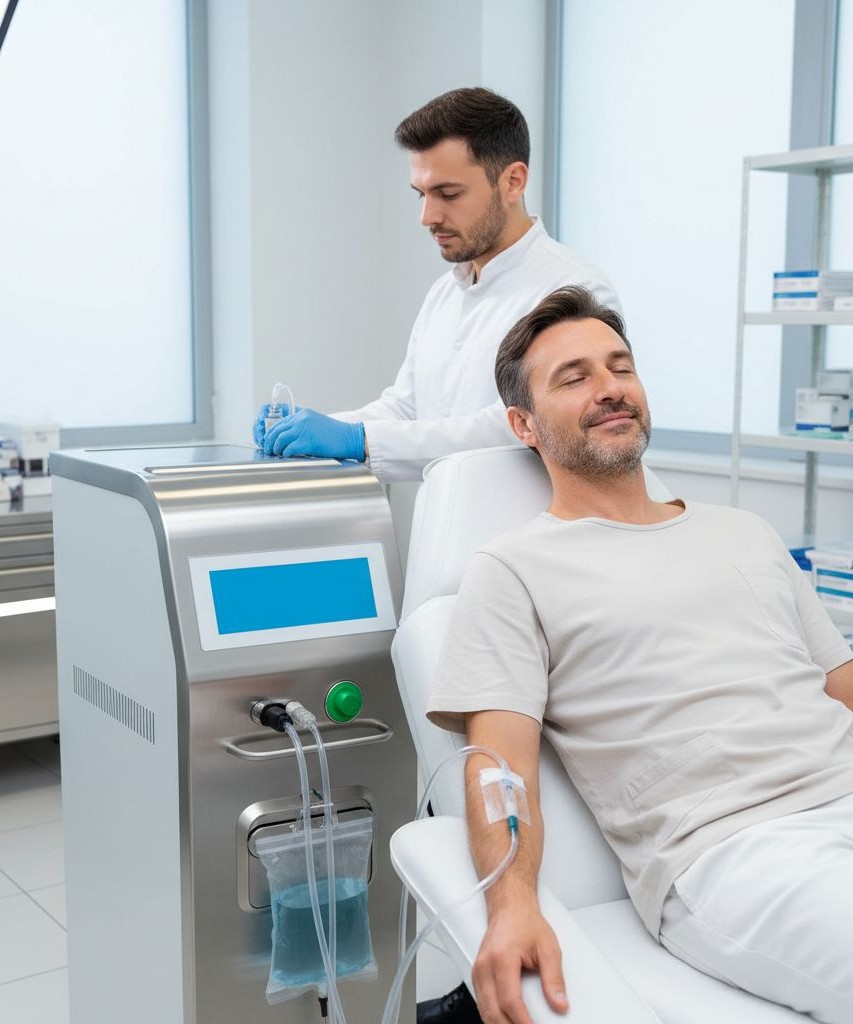
Major Autohemotherapy
This involves drawing blood from the patient, exposing it to an oxygen-ozone mixture, and reinfusing it. It is used for systemic purposes.
Minor Autohemotherapy
Similar to the above, but with a smaller blood volume. It is used in immunomodulatory protocols.
Local Infiltration
Direct application to affected tissues:
- herniated disc
- osteoarthritis
- tendinopathies
- musculoskeletal pain
Intradiscal Discolysis
One of the techniques with the strongest relative evidence for radicular pain due to contained herniated discs.
Rectal Insufflation
A systemic route used in some protocols, with less clinical support.
Topical Applications
- ozone bags for wounds
- ozonated water
- ozonated oils
Indicated mainly for skin lesions, ulcers, and diabetic foot.
Analysis of recent systematic reviews and meta-analyses allows a clear distinction between areas with moderate evidence and those still in the exploratory phase.

Lumbar Herniated Disc
This is the indication with the greatest clinical consistency. Studies show pain reduction and functional improvement in patients with contained hernias, with potential to reduce the need for surgery in certain selected cases. However, the quality of studies remains heterogeneous.
Knee Osteoarthritis
Results suggest improvement in pain and function in some patients, although the magnitude of the effect varies and does not consistently outperform other established infiltrative therapies.
Diabetic Foot and Chronic Ulcers
There is evidence of improved healing and local infection control, always as complementary therapy within a multidisciplinary approach.
Fibromyalgia and Generalized Chronic Pain
Preliminary results show subjective improvements, but without sufficient robust evidence.
Long COVID and Systemic Diseases
Initial studies with small samples and no solid clinical conclusions.
Oncology
There is no evidence to support its use as an anticancer treatment. Its potential role is limited to experimental research on symptoms or side effects.
Risks and Adverse Effects
When applied correctly, ozone therapy has an acceptable safety profile, although it is not without risks.
Reported adverse effects include:
- local pain at the injection site
- infections if sterility conditions are not respected
- hematomas or vasovagal reactions
- tissue irritation
- rare but serious complications such as gas embolism in poorly performed procedures
Ozone inhalation is strictly contraindicated due to its pulmonary toxicity.
There is no clinical recommendation from the WHO endorsing ozone therapy as a standard treatment for specific diseases.
Spanish Agency for Medicines and Health Products (AEMPS)
Ozone is not authorized as a medication. The medical devices that generate it and the medicinal oxygen used in its production are regulated, but its general clinical efficacy is not validated.
FDA (United States)
It maintains a restrictive position and considers ozone a toxic gas with no established medical indications for most pathologies.
Scientific societies
Pain and interventional medicine societies accept its use in very specific contexts, especially in disc pathology. Other specialties do not consider it a standard treatment.
Ozone therapy is legal in Spain as long as:
- it is applied by qualified healthcare professionals
- certified medical equipment is used
- established medical protocols are respected
There are hospital units, especially in the field of pain management, where it is used in selected cases. In the private sector, its presence is more widespread within regenerative medicine and longevity clinics.
There is no official registry of “accredited ozone therapy centers,” although there are scientific societies that bring together professionals trained in this technique.
It must be performed by healthcare personnel, usually doctors with specific training in interventional techniques or pain medicine. It is not a home-use or self-application therapy.
Non-clinical devices available on the market do not guarantee medical safety or efficacy.
Approximate cost
Prices vary depending on the technique and center:
- injections: 80–180 €
- autohemotherapy: 120–250 €
- rectal insufflation: 40–90 €
- complete treatments: up to 1,500–2,000 €
The growth of ozone therapy in longevity and regenerative medicine clinics is driven by three factors:
- biological plausibility related to oxidative stress and antioxidant response
- accumulated clinical experience in certain medical centers
- integration within broader protocols for metabolic health and regeneration
However, the available clinical evidence still does not demonstrate conclusive effects on human aging or life expectancy extension.
This is where the main point of tension between clinical practice and scientific evidence arises: some physicians observe subjective benefits in energy, recovery, or inflammatory markers, while clinical trials still do not allow for general recommendations in longevity.
When it may be reasonable to choose it over other therapies
Ozone therapy may be considered in specific scenarios:
- contained disc herniation with persistent pain before surgery
- patients with high surgical risk
- low back pain resistant to conservative treatment
- chronic ulcers as complementary therapy
- diabetic foot within a multidisciplinary approach
It is not considered first-line treatment for systemic diseases, neurodegenerative diseases, cancer, aging prevention, or performance enhancement in healthy individuals.
Ozone therapy is not situated at the extremes of the medical debate, but in an intermediate space where three realities coexist: plausible biological mechanisms, positive clinical results in specific indications, and still insufficient evidence for many of its most widespread applications.
Its growing presence in regenerative medicine and longevity cannot be understood solely as a matter of proven efficacy, but also as the result of the search for therapeutic tools that act on inflammation, pain, and tissue recovery from a broader perspective.
The current challenge is not to decide whether ozone therapy “works or doesn't work,” but to precisely delimit in which contexts it provides real clinical value, in which it acts as a complement, and in which its use responds more to hypotheses than to consolidated evidence.