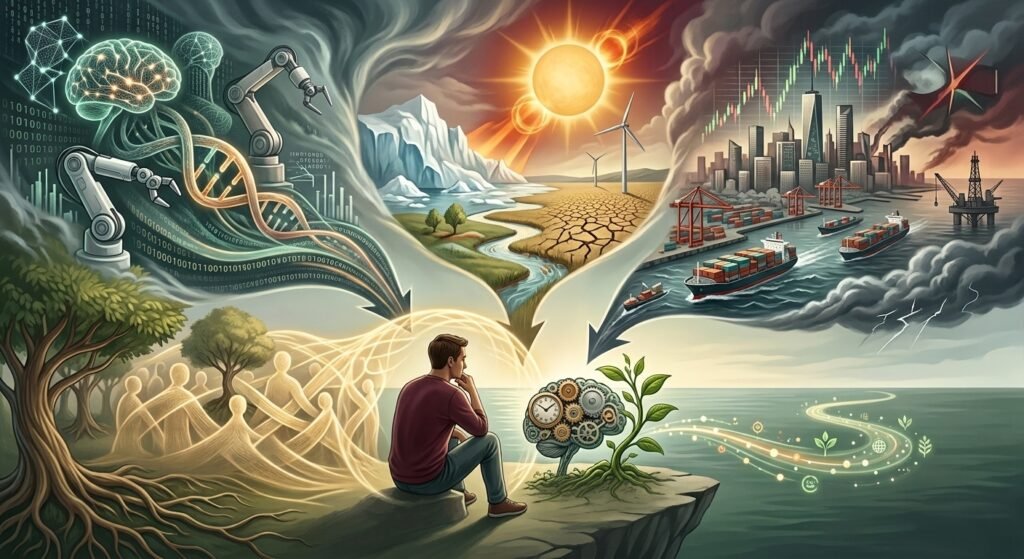
The human organism's responsiveness is currently being measured against pressures that are not biological in origin, but structural. The accelerated deployment of artificial intelligence and workplace automation, episodes of geopolitical volatility, and sudden climate crises do not act solely as macroeconomic variables or press headlines: they operate as continuous neuroendocrine triggers. The tension derived from these phenomena is not limited to fleeting emotional discomfort; it constitutes a factor of organic wear and tear with measurable quantitative consequences for global GDP.
The friction of adjustment: from abstract threat to endocrine response
The human brain processes environmental transformation through a primary cognitive appraisal: it determines whether an event represents a loss, a challenge, or a direct threat to stability. When automation or precariousness forces the restructuring of one's own professional activity, the event is rarely perceived as a neutral challenge. The physiological response is the sustained recruitment of the hypothalamic-pituitary-adrenal (HPA) axis, with the consequent secretion of cortisol and catecholamines.
This prolonged activation disrupts the physiology of natural transition. Individual change models —such as those described by Bridges or Kübler-Ross— establish three well-defined stages: an initial phase of disruption and resistance (characterized by shock and fatigue), a neutral period of reorientation (dominated by disorientation and trial-and-error) and, finally, the consolidation of a new baseline through hedonic adaptation. The contemporary problem lies in the fact that disruptive stimuli overlap without allowing the time needed to complete the third stage.
| Age Group | Developmental Context | Men (Months) | Women (Months) | Key Factors (Strengths [+] and Vulnerabilities [-]) |
| 10 – 19 yrs | Adolescence / Identity | 6 – 14 | 5 – 12 | (+) High neuroplasticity. (-) Emotional turbulence and peer pressure. |
| 20 – 29 yrs | Early adulthood / Independence | 4 – 9 | 4 – 8 | (+) Maximum cognitive flexibility. (-) Economic precariousness. |
| 30 – 39 yrs | Family and career consolidation | 5 – 10 | 5 – 10 | (+) High problem-solving capacity. (-) Financial and family burden. |
| 40 – 49 yrs | Midlife stability | 6 – 12 | 6 – 11 | (+) Emotional regulation. (-) Deeply ingrained habits, high cost of change. |
| 50 – 59 yrs | Transition to late career | 8 – 15 | 7 – 13 | (+) Accumulated experience. (-) Slow restructuring, health issues. |
| 60 – 69 yrs | Retirement / Lifestyle | 9 – 18 | 8 – 16 | (+) Mature perspective. (-) Dependence on rigid routines. |
| 70 – 79 yrs | Third age / Physical decline | 12 – 24 | 10 – 20 | (+) Historical resilience. (-) Social isolation and sensory decline. |
| 80 – 90 yrs | Old age / Dependency | 18 – 30+ | 14 – 26 | (+) Philosophical acceptance. (-) Low neuroplasticity and high fragility. |

Somatization of wear and tear: the toll on physical health
The inability to close adaptation processes generates a constant accumulation of allostatic load: the biological price the body pays for remaining in prolonged alert. This wear and tear is not confined to the psychological sphere but manifests in organic alterations of clinical severity:
- Vascularization and heart: Sustained elevation of blood pressure and the cascade of proinflammatory cytokines accelerate endothelial deterioration, increasing the risk of stroke, refractory hypertension, and myocardial infarction.
- Digestive and immune axis: Alteration of the microbiota-gut-brain axis triggers chronic inflammatory conditions and functional pathologies such as irritable bowel syndrome, as well as inducing secondary immunosuppression.
- Metabolic risk: Sustained excess cortisol alters lipid metabolism and insulin sensitivity, promoting visceral fat deposition, type 2 diabetes, and musculoskeletal pain syndromes from sustained tension.
The macroeconomic dimension: comparison of direct and indirect costs
The impact of lack of adaptation and chronic stress on public and corporate accounts has moved beyond the mental health sphere to become a constraint on global economic growth. The World Health Organization and the World Economic Forum estimate that productivity loss attributable to anxiety and depression amounts to 1 trillion US dollars annually worldwide, reflected mainly in sick leave (absenteeism) and reduced performance at work (presenteeism).
In developed economies such as the United States, costs associated with work-related stress and resulting leave reach 300 billion US dollars per year. The cumulative cost to global GDP from deteriorating mental health is estimated in a range between 5% and 4.5%.
“The economic impact of adaptive decline and chronic stress already exceeds the global financial cost of treating cancer, heart disease, or diabetes.”
When comparing these figures with the most prevalent pathologies worldwide, it becomes clear that the indirect economic cost derived from adaptive wear and tear equals or exceeds the burden of traditional physical diseases:
| Medical-Health Condition | Annual Global Economic Impact (USD) | Primary Cost Pathway |
| Mental Health, Stress, and Anxiety | ~$2.5 to $8.5 Trillion (cumulative direct+indirect) | Massive productivity loss, sick leave, disability, and healthcare treatments. |
| Diabetes Mellitus (Type 1 and 2) | ~$1.3 Trillion | Ongoing pharmacological treatments, dialysis, and amputations. |
| Cancer Diseases (Neoplasms) | ~$1.2 to $1.8 Trillion | High-cost therapies and loss of disability-adjusted life years. |
| Cardiovascular Diseases | ~$1.0 Trillion | Hospitalization, complex surgical interventions, and disability. |

Impact reduction: social cohesion as a protective factor
Despite the depth of these figures, the scientific literature emphasizes the plasticity of the human response when the right conditions are present. Reducing adaptation times and containing biological costs depends not solely on individual resilience, but on the presence of structural buffers.
The most effective documented factor is social buffering (social buffering): belonging to cohesive communities with mutual support networks attenuates the nervous system's reactivity to external uncertainty.
Alongside this, adopting a cognitive reframing —one that allows the transformation to be interpreted as a manageable process rather than an imminent collapse— reduces the duration of the inflammatory response.
The combination of active learning in the face of change (such as ongoing professional training) and effective strategies for emotional regulation constitutes today the most profitable investment for preserving both population health and economic stability.