The pre-congress workshop day will bring together health professionals interested in scientific updates and clinical application on October 1, with a program covering everything from regenerative medicine and inflammation biomarkers to genetics, metabolism, glycation, and the neuroscience of wellbeing.
Longevity medicine is going through a moment of intense scientific evolution. The interest in extending healthy years of life has broadened the field of work for health professionals into areas such as chronic inflammation, the biology of aging, regenerative medicine, genetics, metabolism, and brain health.
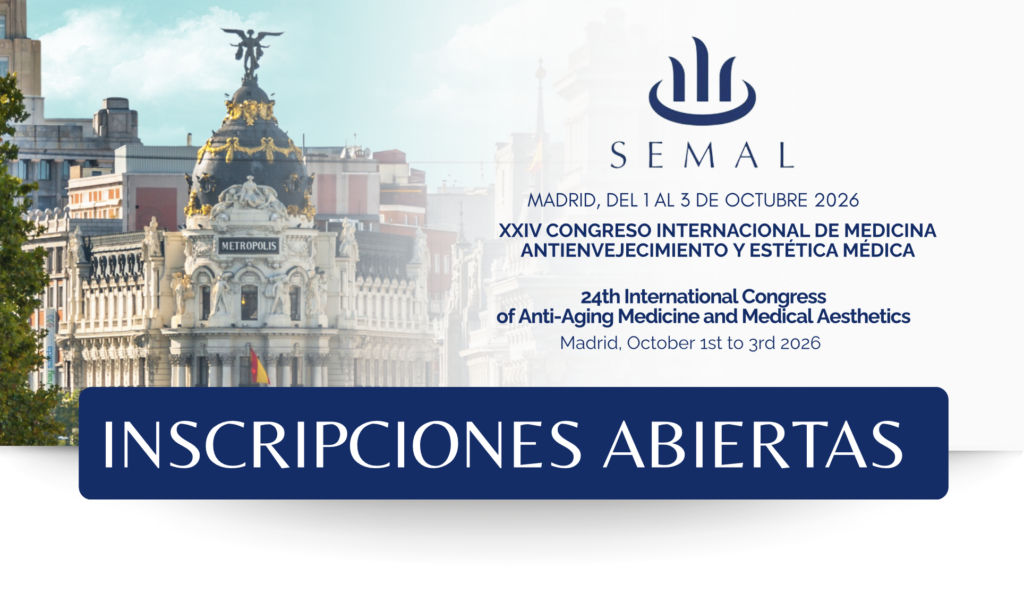
In this context, Madrid will host the upcoming October 1, 2026 a day of pre-congress workshops SEMAL aimed at professionals seeking to incorporate new knowledge and tools into their clinical practice. The event will take place at the Illustrious Official College of Physicians of Madrid and will feature free access.
The program offers a broad vision of clinical longevity, with sessions dedicated both to biological mechanisms related to aging and to their application in medical protocols.
A regenerative ecosystem for longevity
The day will begin at 09:00 with the workshop “Advanced Regenerative Medicine: Understanding the Regenerative Ecosystem and Designing Clinical Protocols for Longevity”, led by Prof. Mike Chan, Dr. Roni Moya, and Dr. Paula Prado.
The session proposes an approach to regenerative medicine from a clinical integration perspective. The concept of a regenerative ecosystem makes it possible to address different tools and mechanisms related to the body's tissue repair and maintenance capacity, as well as their potential incorporation into longevity-oriented strategies.
The interest in this field lies precisely in the need to move from isolated interventions to clinical protocols with defined objectives and follow-up criteria.
Measuring chronic inflammation
At 11:00, attention will shift to one of the major players in healthy aging research: chronic inflammation.
The Dr. María Soledad Andrés and Dr. Jesper Eugen-Olsen will lead the session “Measuring what matters: suPAR in the assessment and management of chronic inflammation in longevity”, focused on suPAR, a biomarker related to immune system activation and inflammation.
Identifying and tracking biomarkers capable of providing information on inflammatory status can be especially relevant in preventive and longevity medicine. The session will address the role of suPAR in the assessment and management of chronic inflammation within this clinical context.
Glycation and accelerated aging
Glycation will take up the next block of the program, starting at 12:00.
The Prof. Manuel Castillo and Antonie Pellet will address “Glycation: Toward a pandemic of accelerated aging? Mechanisms, pathophysiology, and solutions”.
Glycation is related to the interaction of sugars with proteins and other molecules in the body and to the formation of advanced glycation end products, known as AGEs. These compounds have drawn interest due to their connection with aging-related processes and various metabolic alterations.
The session will allow for a deeper look into the mechanisms involved and the potential strategies aimed at reducing the impact of this process.
Technology and aesthetic medicine
The program will continue in the afternoon with a more technology-focused session oriented toward body and facial contouring.
At 15:30, Dr. Daniel Sanchez will present “Endolaser liften: skin tightening, facial and body lipolysis with dual wavelength, power in facial and body sculpting”.
The session will focus on the use of endoluminal laser technology with dual wavelength and its applications in skin tightening and tissue remodeling.
Its presence within a program dedicated to longevity also reflects the breadth that the concept of healthy aging is acquiring in clinical practice, where prevention, metabolic health, regeneration, function, and appearance-related aspects all coexist.
Genetics applied to clinical practice
Genetics will have its space at 16:30 with the workshop “How to integrate genetics into your clinical practice?”.
Incorporating genetic information into preventive medicine opens up possibilities for a more individualized assessment of certain risks and biological characteristics. The challenge for health professionals lies in interpreting that information within a clinical context and preventing an isolated genetic data point from replacing a complete medical evaluation.
Neuroscience enters the longevity conversation
At 17:30, one of the blocks most closely linked to the relationship between longevity and brain health will arrive.
The Dr. Vanesa Pytel will be given by “Neurolongevity: Redefining the Success of Anti-Aging Medicine through the Neuroscience of Wellbeing”.
The concept of neurolongevity focuses on preserving brain function and on those factors that influence cognitive and emotional wellbeing throughout life.
The evolution of longevity medicine has led to greater attention being paid to the quality of years lived. Maintaining brain function, preserving autonomy, and protecting psychological wellbeing are all part of that equation.
Metabolism, microbiota, and GLP-1
The final workshop of the day, scheduled for 6:30 PM, will be dedicated to metabolism and weight management.
The Dr. Gloria Sabater will present “AMPK, microbiota, and GLP-1: the natural approach to optimizing metabolism and improving weight control and satiety”.
The session will bring together three areas of growing interest in metabolic research: the AMPK pathway, the role of gut microbiota, and mechanisms related to GLP-1. The goal will be to analyze their relationship with metabolism, satiety regulation, and weight control from a perspective centered on natural strategies.
The appeal of the program lies in the diversity of disciplines it incorporates. Regenerative medicine, inflammation, glycation, genetics, neuroscience, and metabolism belong to different fields, yet they share a common challenge: better understanding the biological mechanisms associated with aging and finding tools capable of translating that knowledge into clinical practice.
The event will take place on Thursday, October 1, 2026, at the Illustrious Official College of Physicians of Madrid and the pre-congress workshops will be free for interested professionals (RESERVE YOUR SPOT HERE)
More than a succession of talks, the program offers a fairly precise snapshot of where the medical conversation on longevity is heading: from the generic promise of living longer toward the measurement of biomarkers, the personalization of protocols, the preservation of function, and an increasingly broad approach to the mechanisms that determine how we age.