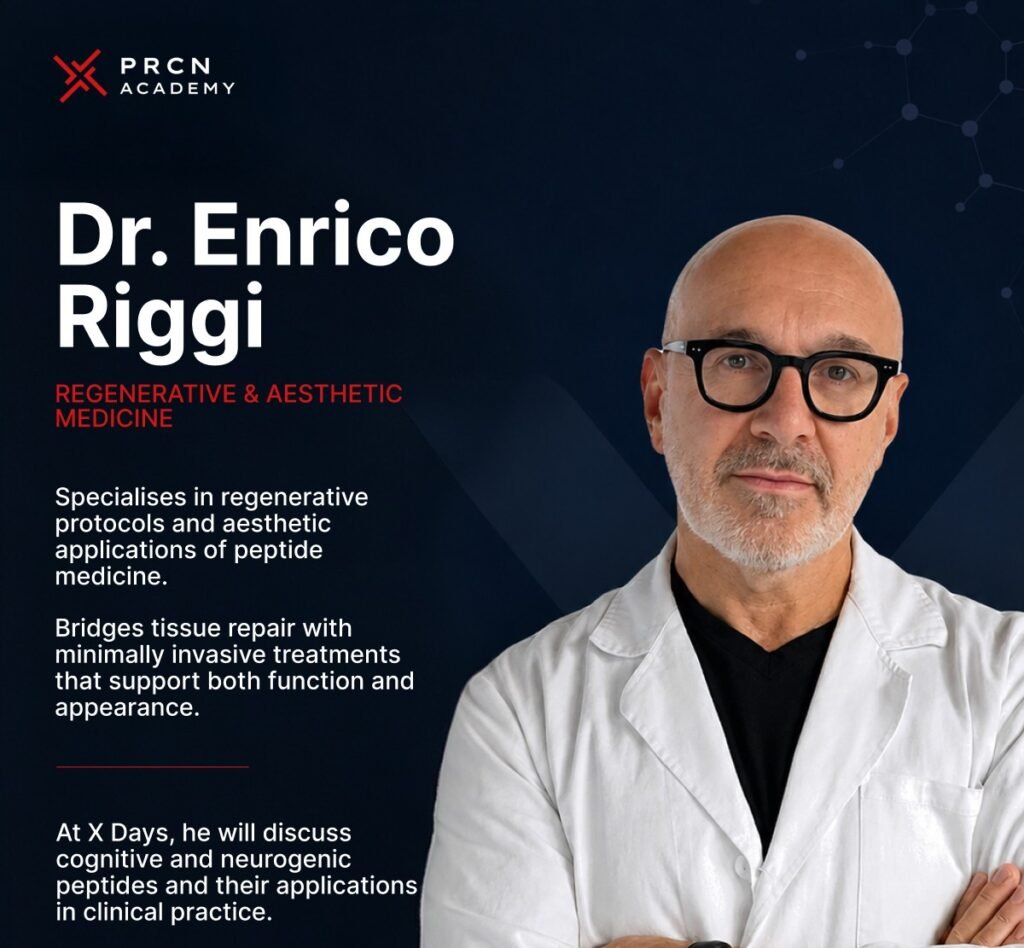
X DAYS – The Peptide Edition I will bring together in Milan doctors and researchers who have spent years working in one of the fields generating the most interest within longevity medicine. Among the speakers is Dr. Enrico Riggi, an Italian surgeon with more than three decades of experience, whose expertise with peptides allows him to approach the phenomenon from a particularly necessary perspective: one that begins with evidence and ends with the patient.
There are topics that burst into the medical consultation after first passing through laboratories, and others that arrive via the reverse path, driven by demand from patients themselves. Peptides today belong to both categories. Some of their applications have consolidated clinical research and are part of perfectly established medical conversations; others remain in study phases, with varying levels of evidence and regulatory questions still open. Meanwhile, the internet has created a parallel space in which molecules, protocols, and personal experiences circulate at a speed that conventional medicine struggles to match.
The doctor Enrico Riggi has spent several years studying this field and applying peptides in his clinical practice with patients from different parts of Italy. His professional career began long before longevity acquired its current dimension. A graduate in Medicine and Surgery from the University of Turin in 1989, he has more than thirty years of experience and a background initially linked to odontostomatology and oral surgery, to which he later added aesthetic medicine and work in longevity medicine, prevention, and advanced therapies. He is a member of the International Longevity Science Association and founder of the Movimento Estensione Vita.
That career path is relevant to understanding his position on peptides. Riggi knows the interest these molecules generate and has been working with them for some time, but he also knows the difficulties posed by a field in which scientific knowledge, medical practice, and the market advance at different speeds.
In conversation with Wellness Forum, the Italian doctor places special emphasis on patient protection. He is aware of the regulatory gaps that still exist around certain substances and believes that risk can increase when consumers purchase products through suppliers that do not offer sufficient guarantees. Familiar-looking labeling or a professional appearance does not by itself allow verification of the origin, quality, traceability, or the conditions under which a product has been manufactured and stored.
The issue takes on another dimension when the patient arrives at the consultation after having educated themselves online for months.
Longevity has generated a particularly active consumer. They seek out biomarkers, interpret lab results, follow research, compare molecules, and quickly find testimonials from people who attribute significant changes in their health or performance to certain treatments. That curiosity can be a magnificent gateway to prevention, though it can also lead to decisions made based on incomplete information or products purchased outside sufficiently controlled healthcare channels.
Riggi knows that patient profile and precisely points to the importance of medical expertise accompanying the expansion of this market. In his view, knowledge of peptides requires years of research and clinical practice, because each patient introduces variables that do not appear in a generic protocol. Case selection, prior assessment, monitoring of response, and the ability to modify or stop an intervention are all part of that knowledge.
It is an experience that is difficult to acquire by reading about a molecule alone.

And it is precisely that clinical dimension that explains the interest in his participation in X DAYS – The Peptide Edition Iwhich will be held on October 9 and 10 at STEP FuturAbility District, Milan. The organizer, PRCN Academy, has designed two days that combine scientific training, clinical discussion, practical application, and professional networking. The program consists of fourteen modules and includes clinical presentations, protocol design, Q&A, and case work.
Riggi will speak during the second day with a session dedicated to cognitive and neurogenic peptides. His talk will be part of a track that begins that day with this subject and continues with mitochondrial longevity, led by Maritza Novas, and immune modulation and resilience, presented by Aletta Sørensen.
Friday the 9th's program offers a complementary perspective. Ksenia Butova will open the scientific portion with the fundamentals of peptide medicine and clinical reasoning; Antonio Milocco will address metabolic peptides and incretin medicine; Massimo Spattini will cover the GH axis and secretagogues, and Christie Prendergast will discuss regenerative medicine with peptides. Among those blocks there is a session specifically dedicated to regulation, quality and clinical governance, a particularly pertinent issue in an area where patients may encounter products and protocols from very different markets.
The second day expands the framework even further. Fabrizio Golonia will address hormonal axes, hormone replacement therapy, and its integration with peptides, while Aletta Sørensen and Maritza Novas will work on the complete patient journey within precision longevity. The program also includes a session dedicated to peptide marketing in clinical practice, led by Daniela Gallo, and a block on precision testing and biomarker measurement.
The composition of the faculty reinforces that breadth. PRCN Academy presents Antonio Milocco as a specialist in peptide therapies and regenerative medicine; Massimo Spattini, linked to anti-aging medicine, functional nutrition and hormonal optimization; Aletta Sørensen, focused on clinical research and longevity science; Fabrizio Golonia, endocrinologist specializing in hormonal health and metabolic medicine; Christie Prendergast, plastic surgeon with a practice that integrates regenerative medicine, precision and longevity; and Ksenia Butova, founder and CEO of Longevium Clinic Dubai, specializing in personalized longevity medicine. Riggi appears within this structure with his specialization in regenerative protocols and aesthetic applications of peptide medicine.
The interest in bringing together different profiles around peptides has an obvious reason. A molecule that acts on a metabolic pathway raises different questions from one linked to regeneration, immunity, mitochondrial function or neurogenic activity. Medical practice also forces the introduction of variables that the market tends to simplify: patient history, concomitant medication, therapeutic goals, biomarkers, follow-up and individual response.
That is probably one of the most interesting values of a training program of this type. The professional can know the scientific literature and, at the same time, need clinical references that allow them to interpret how certain strategies behave in practice. Listening to doctors who have been working with patients for years provides a layer of knowledge that can hardly be replaced with fragmented information from the internet.
Riggi represents precisely that transition between research and clinical practice.
His career, moreover, allows peptides to be placed within a broader professional evolution. His current work in longevity is built on a medical experience that began more than three decades ago, to which he has been incorporating new tools and fields of knowledge. The professional document provided for this interview notes his activity in preventive, integrative and optimization medicine, as well as his specific interest in peptide research and advanced therapies.
The timing chosen to hold X DAYS is also significant. Longevity medicine is growing at the same time as demand for increasingly specific interventions grows. The patient who used to ask about nutrition, exercise or supplementation may now come to the consultation asking about incretins, secretagogues, regenerative peptides, molecules related to immunity or strategies targeting certain metabolic pathways.
The doctor needs to be prepared to respond.
That implies knowing both the science and the frontiers of that science. In some areas relevant clinical data exist; in others, results come from preclinical research or still-limited evidence. Specialized training precisely allows each tool to be placed in its context and prevents a promising molecule from ending up presented to the patient as a solution whose efficacy and safety are fully established.
The very design of X DAYS points toward that need. The organization presents the meeting as an educational experience aimed at doctors, functional and integrative medicine professionals, aesthetic doctors, dentists, pharmacists, nutritionists, healthcare professionals and clinic managers. Among the elements included are clinical presentations, protocol design, work with cases in small groups, interactive sessions and a networking space with European longevity professionals.
For those working in this field, the possibility of talking directly with other professionals can be as interesting as the content of the presentations. Longevity medicine is still building part of its language, its protocols and its practice criteria, and meetings between specialists allow the exchange of experiences that rarely appear complete in a scientific publication.
In that context, peptides constitute one of the most fascinating and controversial territories of contemporary medicine. Fascinating because of the variety of biological processes on which they can act and because of the research they are generating. Controversial because of the distance that exists between certain commercial expectations and the real level of evidence available for some applications, in addition to the regulatory and quality differences that can be found between products and markets.
The experience of doctors like Riggi takes on a practical dimension here. Understanding peptides also means understanding the environment in which they are being used, the questions patients ask, and the problems that can arise when scientific information quickly transforms into a consumer decision.
The longevity market will continue to grow regardless of whether medicine is prepared to respond to it or not. The difference will lie in who establishes the criteria by which that market is interpreted: trained professionals capable of explaining evidence, limits, and risks, or a digital ecosystem in which the boundaries between research, personal experience, and commercial promotion can be difficult to distinguish.
X DAYS precisely raises the possibility of getting ahead of that situation through training and direct contact with professionals who have been working in the field for years. Enrico Riggi will arrive in Milan with clinical experience accumulated over decades and with several years of research and practice around peptides. Around him will be specialists such as Milocco, Spattini, Sørensen, Golonia, Butova, and Prendergast, each from a different discipline, in addition to the rest of the professionals who complete the program.
The proposal is of interest to anyone who wants to understand where longevity medicine is heading before trends end up imposing their own language. Two days dedicated to peptides allow an approach to the subject from research, clinical practice, regulation, biomarkers, and patient follow-up, but also from something that is particularly valuable in a young discipline: the experience of those who have been working with it for some time.
For a longevity professional, attending means entering a conversation that is already happening in consultations, in research, and in the market. The difference lies in doing so accompanied by doctors who have been studying the subject for years and can contribute something that no algorithm or product catalog can offer: clinical judgment built from knowledge, practice, and experience with patients.